
The Wrong Collapse
Iran is deteriorating – that is not the same as collapsing

The predictions of Iranian economic collapse consistently specify how it will happen, but that pathway is not applicable to Iran. What is actually happening is different, slower, and considerably more durable than the proponents of the collapse thesis acknowledge.
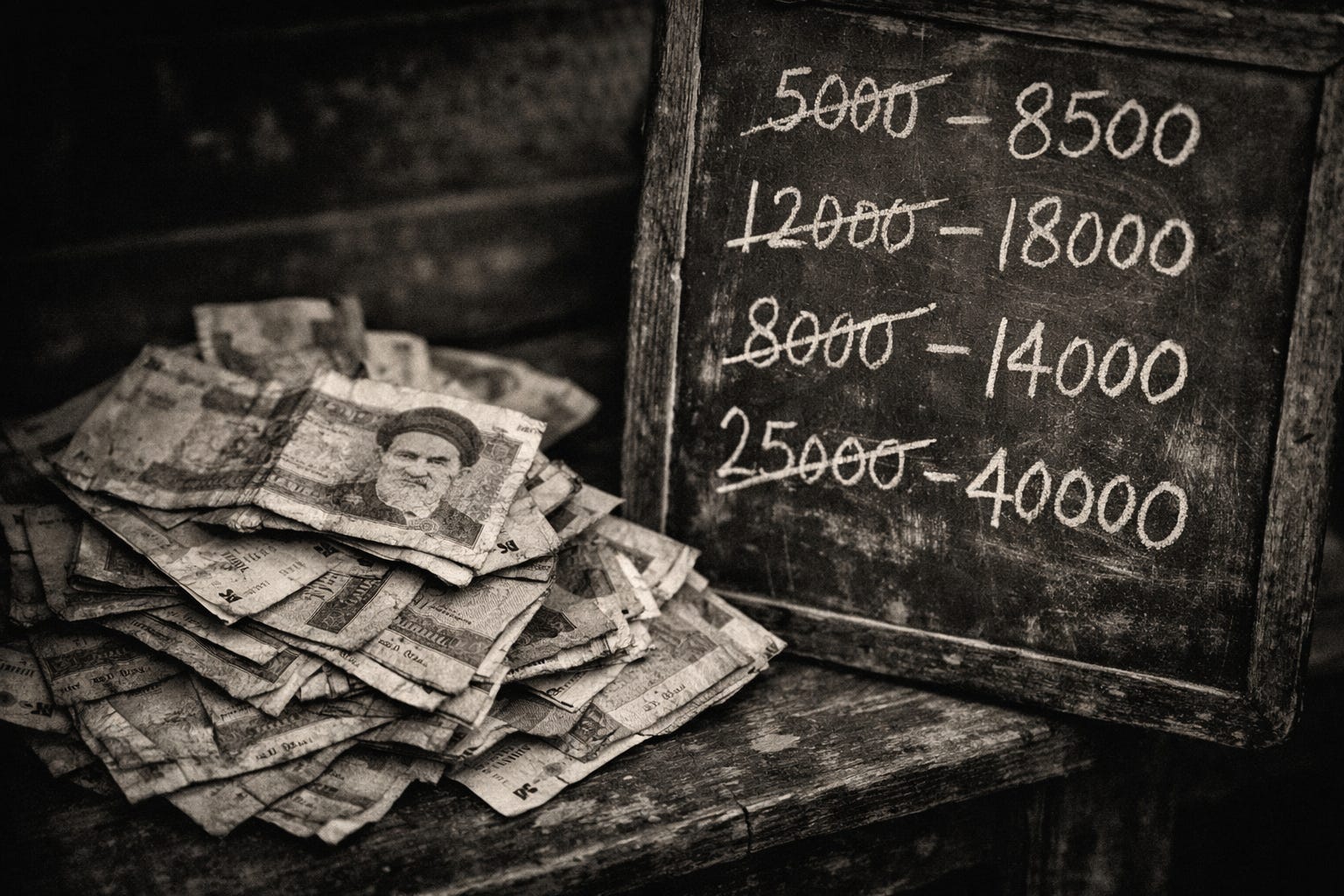
The prediction in Western commentary since 13 April – that the blockade will produce Iranian economic collapse and regime change – is more specific than a bad-outcome forecast. It describes a particular sequence for how economies collapse rapidly: export ‘revenues’ are cut, the currency falls, hyperinflation follows, coercive capacity breaks, and the population removes the regime. That sequence has historical precedents: an external debt crisis, a fixed exchange rate failure, a bond market rejection of sovereign debt. The collapse predictions are drawing on one or more of them, whether their proponents know it or not.
However, Iran lacks the conditions any of those three processes requires to operate and that distinction affects the entire understanding of what could happen.
In the Sovereign Risk Series I developed a framework separating how easily stress enters a sovereign system – its probability of crisis – from how far the stress travels once inside – its severity. Iran presents an unusual combination: near-zero probability of financial-crisis entry through the standard channels, alongside high and rising severity of deterioration once the shock is inside the system. Treating severity as evidence of a particular collapse pathway is where the commentary goes wrong.
What collapse actually requires
Economic collapse requires a specific vulnerability that, once activated, produces a self-reinforcing spiral. Three distinct processes have driven the historical cases.
The first process is through foreign currency debt combined with a fixed exchange rate or credible peg. Germany’s Weimar hyperinflation is the most-cited example and the most consistently misunderstood. The standard account blames money printing, but the correct account begins with reparations. The Allied schedule denominated Germany’s obligations in hard currency – gold marks, then foreign exchange. The German Government purchasing foreign exchange to meet those obligations bid up the price of that FX in marks, thus pushing the value of the mark downward. Prices increased as the exchange rate fell, and note circulation needed to expand to accommodate the higher nominal price level, not to cause it. The contemporary economist Helfferich observed that note circulation “did not precede the rise in prices and also that it followed it but slowly and at some distance of time”.
The Weimar Government was required to buy foreign exchange regardless of price. This continuous hard-currency purchase obligation was what made the spiral self-reinforcing, amplified by fiscal expansion and speculative dynamics.
What ended the hyperinflation was Hjalmar Schacht – the Reichsbank president – stopping the bidding. The mark-dollar rate was fixed, cutting off speculative credit for FX purchases, and the Dawes Plan restructured the reparations obligation that had made continuous FX purchases mandatory.
Argentina’s multiple crises follow a similar pattern – dollar-denominated debt plus a fixed exchange rate – and when reserves deplete and the peg breaks, obligations become unserviceable overnight.
The second process requires no foreign currency debt at all. Zimbabwe’s hyperinflation followed the farm seizures from 2000. Agricultural exports – the primary hard-currency earner – collapsed, and food production fell, requiring imports at exactly the time when the means to pay for them had gone. With the productive base destroyed, the government monetised its fiscal deficit, and falling confidence, banking dysfunction, and accelerating velocity of money drove the shortage into a spiral. Venezuela’s path was more gradual – prolonged institutional decay, oil dependence, and policy-driven supply collapse – but once the productive base contracted, the government monetised the resulting fiscal deficit and inflation followed a similar route.
A third process is loss of monetary sovereignty itself. Euro membership removed Greece’s ability to adjust through currency, so when its obligations became unserviceable without external support, the only path was austerity on externally imposed terms, which is what gives that crisis its cliff-edge character.
Why Iran’s structure forecloses these processes
As set out in How Sovereigns Actually Fail, the first question for any sovereign is whether the state controls the currency it borrows in. Iran does – it issues rials, borrows in rials, and funds its domestic operations in rials. A bond market panic cannot force classical funding insolvency – it can cause inflation, and it is doing exactly that, but the funding exhaustion that drives sovereign default is not applicable to it.
Iran has minimal foreign currency debt. There is no dollar-denominated sovereign obligation that becomes unserviceable when the rial falls. There is no currency board or credible peg to break – the gap between the Central Bank of Iran’s official rate and the parallel market has existed for years and is a feature of the sanctions-adapted system, not a crisis trigger. The rial is already floating and extensively depreciated, hence there is no fixed rate to defend and therefore none to break.
The Weimar dynamic specifically requires a mandatory hard-currency purchase obligation at continuously higher prices. Iran has no equivalent. The FX purchases Iran makes are for imports, a practical necessity for keeping the economy running, not a legally binding schedule demanding a fixed quantity regardless of price. When the blockade prevents those imports, the state’s mandatory ‘import-FX purchase’ loop is actually capped by the import denial of the blockade itself. The mandatory purchase loop that made Weimar’s acceleration self-reinforcing is absent from Iran’s case.
Private-sector demand for foreign currency operates on a different basis: households, firms, and parallel-market actors continue bidding for dollars or gold as a hedge against further depreciation, and that pressure does not depend on what the state is importing. The inflationary consequences of this expectation-driven dynamic are a separate problem, addressed below.
The IRGC and the internal security apparatus are paid in rials. As set out in The Sewer Pipe Theory of Regime Change, cutting exports does not directly cut that payroll. The indirect effects are real – dollar shortages degrade the purchasing power of rial wages, constrain imports of fuel additives and spare parts, and erode operational capacity over time – but these are slow, second-order effects, not the rapid fiscal crisis that a Weimar or Argentine collapse requires.
Britain in 1976 illustrates what monetary sovereignty’s practical limits look like under external pressure. Britain was a full monetary sovereign – its own currency, floating exchange rate – and still faced a crisis requiring an IMF bailout. The conditions producing it were financial: sterling balance holders could exit, the gilt market could experience a buyers’ strike, and the public sector borrowing requirement needed external financing that creditors could withhold. Iran has no such actors – no external creditors hold rial assets. Iran’s actual limit is physical – it cannot import what the blockade prevents from arriving, regardless of how many rials the central bank creates. Britain 1976 shows that monetary sovereignty has practical limits under external pressure, but those limits do not apply to Iran because the conditions that produced them in Britain are absent here.
What Iran is actually experiencing
Iran is experiencing inflationary-distributional compression – a sustained deterioration in living standards and real output driven by supply shortage and monetary accommodation, rather than by any financial trigger. Import denial reduces the available stock of industrial inputs and consumer goods, so the central bank creates rials to fund war spending, welfare, and subsidies, and as more rials chase fewer goods the price level rises.
The figures are severe. The Central Bank of Iran reports 12-month average inflation to end-March 2026 at 54%, and point-to-point inflation at 74%. The Statistical Centre’s CPI, base year 2021, reached 542 in March – prices have more than quintupled in four years. Food and beverage inflation is running at 113% year-on-year. The IMF projects a 6.1% real GDP contraction for 2026 alongside 69% full-year consumer price inflation. The parallel market rial stands at approximately 1.8 million to the US dollar, a 67% depreciation over six months. Iran’s deputy work minister confirmed two million jobs lost since 28 February.
Reinhart and Rogoff define an inflation crisis as annual inflation above 20% and hyperinflation at above 500%. Iran is well past the inflation crisis threshold and well below the hyperinflation threshold – for now. Donya-e Eqtesad, Iran’s main financial newspaper, set out three forward-looking scenarios in late April: a deal produces 49% inflation for the year; continued stalemate produces 67%; and renewed conflict produces 123%. Donya-e Eqtesad is correct to treat this as an inflation question rather than a solvency question, because that is what it is.
The supply-side picture understates two related risks. One is that inflationary spirals accelerate not just through goods scarcity but through falling willingness to hold the domestic currency. Money velocity rises as people shorten transaction horizons, convert rials into gold or foreign assets, and price future deliveries in hard currency rather than rials. Iran’s widening parallel markets and barter arrangements reflect this expectation-driven pressure. The other risk is banking disintermediation: as confidence in rial-denominated deposits erodes alongside confidence in the currency itself, deposit flight and shadow settlement systems develop, compounding the monetary dysfunction that the inflation data reflects only partially.
The Zimbabwe comparison fits the basic dynamic but needs one qualification. Zimbabwe’s productive collapse was agricultural: once farms were seized and expertise dispersed, rebuilding from nothing took years. Iran’s hydrocarbons remain physically intact and extractable for now, though extended shut-ins carry reservoir damage risk. The blockade prevents exports, but it does not destroy the underlying industry wholesale in the way Zimbabwe’s farm seizures did. A ceasefire restores exports, which is part of why the slope is long rather than terminal.
North Korea after the Soviet trade collapse in the early 1990s illustrates one thing directly relevant here: prolonged attritional deterioration is compatible with regime survival. A monetary sovereign with no significant external debt and under severe trade isolation, the North Korean state survived extreme deterioration – including the 1990s famine – through systematic distribution prioritisation to the military and security apparatus, letting civilian welfare absorb the compression. The differences between North Korea and Iran are substantial – Iran has a larger and better-informed urban population, greater factional complexity, and the specific problem of missing arbitration – all of which make any close comparison misleading. However, the precedent makes the narrower point adequately: extreme economic deterioration does not automatically produce the political outcome the pressure campaign is designed to achieve.
Dalio identifies the point at which an inflationary spiral becomes self-reinforcing as the moment when monetisation is needed while inflation and currency weakness are already present. The central bank is caught between printing to sustain the system and not printing to limit the currency fall. Iran is in that zone. Whether the spiral accelerates or stays in its current attritional pattern depends primarily on whether the supply shortage intensifies further: whether the blockade runs long enough to exhaust floating storage, force shut-ins that risk permanent reservoir damage, and substantially cut overland import volumes. None of those questions has a settled answer.
The mechanism that actually threatens the regime
The collapse-through-economic-pressure argument assumes that severe enough deterioration eventually breaks the regime’s coercive capacity, whereupon the population removes it. That assumption fails because authoritarian regimes do not distribute economic pain the way markets do, as North Korea illustrates. Instead they direct scarce goods to the security apparatus and let civilian welfare deteriorate, and that remains a politically sustainable approach as long as the regime can control who gets what. Economic deterioration becomes regime-threatening only when political fragmentation prevents the state from directing scarcity toward the institutions that keep it in power.
The assumption buried in that argument – that economic suffering eventually produces a popular uprising sufficient to remove the regime – does not fare well historically. Saddam’s Iraq survived sanctions-era deprivation until an external military force ended it. North Korea has endured prolonged trade isolation and famine without popular removal. The Arab Spring generated regime change in two clear cases where security apparatuses were relatively shallow or unwilling to kill in the numbers required. Yet where they were robust and ideologically committed, the same economic conditions produced suppression or civil war. Iran has drawn the lessons from those cases. The internet shutdowns are designed to prevent the distributed coordination that allowed the 2011 uprisings to scale – that is their function, and it is distinct from ordinary censorship. The IRGC and Basij are organised around ideological commitment and economic integration with the regime rather than conscription, giving the security apparatus no rational incentive to defect. The regime has demonstrated repeatedly – 2009, 2019, 2022, 2026 – that it will use lethal force in whatever degree is needed. A fuller account of the history and processes of popular uprisings and regime change belongs to a separate piece, but here it is enough to note that the pathway from economic deterioration to regime removal depends on a popular uprising that the historical record does not support.
The threat that economic deterioration does pose is distribution failure and missing arbitration, and this is where the economic analysis connects with the political one identified in The Arbitration Is Missing. The problem is not that Iranian leadership is divided – factionalism is the designed operating condition of the Islamic Republic – but that the arbitration function is gone. Khamenei’s role for 37 years was to hear competing institutional positions and produce unified decisions. The factionalism remains, but the war has suspended that conversion function. The IRGC can declare Hormuz closed and the Foreign Minister can announce it open – both positions can be institutionally coherent and practically incoherent at the same time, because there is no authority currently converting them into a single decision. Hence we get Schrodinger’s Strait.
In the Sovereign Risk framework, what is degrading is Political-Institutional Capacity, the third foundation. Distribution decisions that require unified authority across competing institutions are being made without that unity. The institutions responsible can determine which sector receives the next fuel allocation, which import category gets the next tranche of FX, or which faction’s military priorities prevail in the budget. However, simultaneous alignment across the system is problematic, so the result is accelerated misallocation: resources deteriorating faster than aggregate figures suggest, because the allocation system is operating at reduced capacity.
The path ahead
Iran’s economic trajectory is a long slope. Ongoing supply shortage, accelerating inflation, rial depreciation, and distribution misallocation will continue producing measurable damage – falling real incomes, expanding rationing, widening parallel markets, increasing currency substitution and barter, and rising civilian hardship. But it will not produce sudden financial collapse, because the conditions for that are absent.
Resolution will require something analogous to the Schacht sequence: a credible new monetary anchor, along with a restructuring of the underlying pressure that has been driving the price level upward. For Iran, that means a ceasefire restoring at least partial export access, which then makes a new anchor credible. The political economy of introducing that anchor into a sanctions-adapted, factionalised system, where the parallel market is the effective exchange rate, is not trivial. Schacht had the Dawes Plan rescheduling reparations and an international loan providing hard-currency backing for the Rentenmark. Iran’s equivalent requires a negotiated outcome the current stalemate shows no clear path toward.
The collapse predictions are treating the severity of what is happening as evidence of what is coming next. Iran’s economy is in serious and worsening distress – Political-Institutional Capacity is degrading, resource availability is under sustained pressure, and private-sector fragility is rising – but the deterioration is inflationary and distributional rather than financial in character. The regime’s exposure runs through distribution misallocation and missing arbitration, not through the exchange-rate or debt dynamics that produced the historical collapses the predictions invoke. Iran is deteriorating. That is a genuine and worsening problem, but it is not the same as collapsing.
REFERENCES
Data
Central Bank of Iran – monthly inflation and CPI release, March 2026.
IMF World Economic Outlook, April 2026.
Iran Ministry of Labour – deputy minister statement on employment, April 2026.
Statistical Centre of Iran – Consumer Price Index, base year 2021, March 2026.
Iranian press
Donya-e Eqtesad – forward inflation scenarios, April 2026.
Historical and scholarly sources
Armstrong, P. and Mosler, W. (2020) ‘Weimar Republic Hyperinflation through a Modern Monetary Theory Lens’ – reparations-FX bidding mechanism and stabilisation analysis.
Dalio, R. (2024) How Countries Go Broke, Simon & Schuster – inflationary depression template and spiral inflection point.
Helfferich, K. (1927) Money (trans. Louis Infield), Augustus M. Kelley, New York – the observation on note circulation following rather than preceding prices is from pp. 597–602.
Fullwiler, S. (2016) ‘The Debt Ratio and Sustainable Macroeconomic Policy’, World Economic Review, 7, pp. 12–42 – sector financial balances and monetary sovereign debt dynamics.
Fullwiler, S. (2020) ‘When the Interest Rate on the National Debt Is a Policy Variable (and “Printing Money” Does Not Apply)’, Public Budgeting & Finance – monetary sovereignty and fiscal sustainability framework.
Fullwiler, S., Grey, R. and Tankus, N. (2019) ‘An MMT Response on What Causes Inflation’, FT Alphaville, 1 March – supply-side versus demand-pull inflation distinction.
Reinhart, C.M. and Rogoff, K.S. (2009) This Time is Different: Eight Centuries of Financial Folly, Princeton University Press – inflation crisis and hyperinflation thresholds.
Roberts, A. (2016) When Britain Went Bust: The 1976 IMF Crisis, OMFIF Press – Britain 1976 mechanism and resolution.
You belong in a powerful think tank where those in power at least must hear and consider your analysis output and the policy implications.