
Probability and Severity
Part 4 of the Sovereign Risk Series

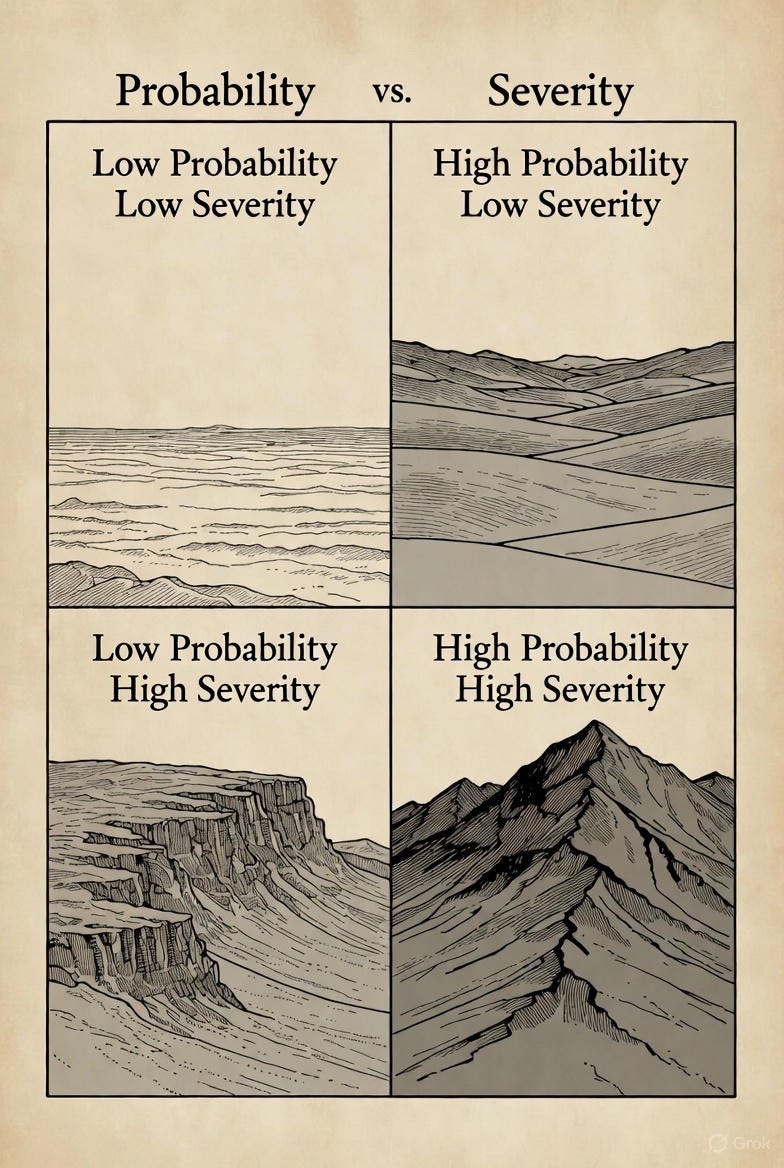
There is a point, somewhere in the course of sovereign analysis, when you realise that knowing what a state is made of is not the same as knowing how it will break. A sovereign can look settled for years. Then something small shifts – the currency twitches, yields widen by a sliver, foreign funding hesitates – and suddenly the system feels exposed in a way the usual indicators never warned you about.
Stress does not enter every sovereign in the same way. In some places it flows in easily, almost freely, but in others it struggles to cross the threshold at all. Some states amplify pressure, while others absorb it with little visible disturbance.
This is why the familiar habit of calling a sovereign “high risk” or “low risk” starts to feel thin once you look closely. Those labels compress what is, in practice, a far more varied landscape. A country may experience frequent wobbles yet remain structuring resilient, while another can drift through years of calm only to discover that, when a shock finally arrives, it travels further than expected.
It is more useful to separate fragility into two dimensions: Probability, which describes how easily stress enters the system, and Severity, which describes how far it travels once inside.
Once you see the world this way, countries stop behaving like rankings and start behaving like places – positions on a map shaped by structure, history, and the routes stress prefers to follow.
Probability: How Easily Stress Enters
Probability in this framework refers to permeability – it is not a forecast of crisis, but an assessment of how easily external forces find an entry point, how exposed a sovereign’s financial edges are, and how quickly global conditions can rearrange domestic balances.
Certain patterns recur:
Capital that can exit quickly
Deep, liquid markets where global capital can build sustained positions
FX exposure that widens the channel
External liabilities that must roll
Dependence on global rate cycles
Rather than weakness, these characteristics describe openness – the extent to which global conditions can register quickly in domestic prices.
And the cleanest illustration came in late 2022.
Korea 2022 – A High-Probability Wobble
By domestic measures, Korea began 2022 in good order, with steady growth, well-capitalised banks, and routine politics. Nothing appeared materially misaligned.
The shift came from outside. The dollar surged as the Federal Reserve tightened at a pace few major central banks matched, global liquidity thinned, and the won depreciated sharply, at one point losing close to a fifth of its value against the dollar. Offshore funding costs rose and short-dated capital exited with little friction.
The pressure came from the global tightening cycle moving through Korea’s open financial channels. What mattered was how it evolved. The Bank of Korea intervened, reserves were deployed as intended, markets adjusted, and the volatility subsided without feeding materially into domestic instability.
Korea in 2022 illustrates high Probability with limited Severity: a sovereign that global conditions can reach quickly, but where the internal structure restricts how far the shock travels.
Probability, then, concerns reachability – the amount of external force required before a sovereign’s financial conditions begin to move The second dimension is Severity.
Severity: How Deeply Stress Travels
Severity concerns transmission. Once pressure enters the system, the relevant question is how it moves – which institutions it encounters, which balance sheets it touches, and how far into the political and financial structure it reaches?
Severity tends to rise when:
Political fragmentation that impairs policy response
Persistent low trend growth limiting shock absorption
Banking systems that tighten credit under stress
Limited fiscal capacity to absorb shocks
Weak policy credibility or coordination failures
Legacy balance-sheet vulnerabilities from prior crises
A high-severity sovereign may appear stable for extended periods, yet once a shock enters it tends to follow established transmission routes and penetrate more deeply into the system.
Probability concerns the threshold; Severity concerns the terrain the shock encounters once inside.
Where Countries Sit on the Plane
When reachability and depth are considered together, sovereigns cluster in ways that conventional analysis rarely captures.
South Korea sits high on probability, low on severity. External conditions register quickly, but the institutional and fiscal structure has so far limited how far stress travels.
Turkey sits high on both dimensions. Pressure enters frequently and tends to propagate through currency dynamics, policy credibility and balance-sheet exposure.
Japan remains low on both. Its funding structure and investor base make it difficult for shocks to gain traction, and once they do, transmission tends to be contained by domestic absorption capacity.
Australia sits in the middle ground. It is financially open and sensitive to global cycles, yet institutional coherence and policy flexibility have historically limited propagation; the depth of any episode is likely to depend heavily on household leverage and the fiscal stance at the time.
Italy tilts toward high severity. Probability fluctuates with broader euro-area sentiment, but once stress enters it encounters slow structural growth, political turnover, banking constraints and the limits imposed by eurozone fiscal architecture. That does not imply inevitability of crisis, only that transmission channels are well understood by markets.
Why the Plane Matters
Conventional rankings compress sovereign fragility onto a single scale. In practice, reachability and transmission vary independently, and the interaction between them determines how a shock unfolds.
Thinking in two dimensions allows those dynamics to be assessed before stress becomes visible in the data. It clarifies where market pressure is likely to register first and how far it may propagate once inside the system. It also provides a way to analyse how countries shift position over time as fiscal settings, balance sheets and policy credibility evolve.
Part 5 examines how sovereigns move across that plane when global conditions change abruptly.