
Why Debt/GDP Is Witchcraft
Part 1 of the Sovereign Risk Series

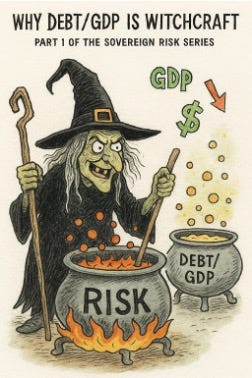
If you want to understand why sovereign-debt debates keep going in circles, start with the strangest fact in modern economics: the most widely used measure of sovereign risk – debt/GDP – does not actually measure sovereign risk. It measures the political and psychological temperature of the audience. Nothing more.
Yet we still build fiscal rules around it, model crises with it, and treat its movements as if it were some deep equilibrium signal rather than a superstition inherited from the 1990s. This sounds harsh, but look at the evidence. It is all around us.
Japan runs public debt at around 240% of GDP and enjoys some of the lowest borrowing costs in human history. Italy sits at just over half that level and flirts with crisis every five years. Australia has 40% debt/GDP and still acts like it is one rating downgrade away from fiscal purgatory. You can twist yourself into any shape to justify this incoherence, but the simpler truth is that debt/GDP is a bad instrument for a job it was never designed to do.
It tells you nothing about actual solvency.
It tells you everything about narratives – and about who happens to believe them.
The Mechanical Failure
If you were designing a measure of sovereign risk from scratch, you would not begin with debt/GDP. You would start with a handful of basic questions.
Does the state issue the currency it borrows in?
Can it mobilise real domestic resources without immediately hitting inflation or external constraints?
Will its political system fracture under pressure or hold?
Is the private sector stable enough to avoid dragging the state into a crisis?
Debt/GDP answers none of these. It binds a stock (public liabilities) to an unrelated flow (national output) and pretends this ratio captures “capacity to repay”. That logic is borrowed from household and corporate finance, where bankruptcy and finite horizons exist. Governments with their own currencies do not extinguish debt; they roll it. Their liabilities do not operate like a mortgage schedule.
GDP has no intrinsic relationship to a sovereign’s monetary capacity, and the debt stock does not tell you whether obligations can be met in the currency the sovereign itself issues. A metric can be neatly expressed without being meaningful.
The Empirical Failure
The evidence from the past thirty years is blunt. The crises we actually experienced bear no resemblance to what debt/GDP would have predicted.
Japan accumulated debt for decades without approaching crisis.
Argentina defaulted repeatedly with ratios far below Japan’s.
Asian crisis economies had low public debt and still collapsed.
Eurozone members with wildly different debt ratios suffered nearly identical funding stress once the ECB backstop was uncertain.
And then there is the UK gilt shock of September 2022. Between August and September, Britain’s debt/GDP barely moved – 60% to 61%. Yet long-term gilt yields surged by more than 130bp in a few days. Pension funds faced collateral calls. The Bank of England had to intervene to prevent a full-scale liquidity spiral.
If debt/GDP were a diagnostic, nothing changed. But something very real did.
When a metric fails mechanically and fails empirically, it does not leave much to defend.
Why It Persists
Debt/GDP survives for reasons that have little to do with insight. Markets need a focal point. Policymakers need a number that can anchor debate. Debt/GDP plays that role – it creates a shared script even when the script is wrong.
When enough participants believe a variable signals danger, the belief gives it force. Spreads widen because traders assume others will react. Politicians respond because they assume markets will respond. Commentators replay the ritual because it feels like prudence.
What we witness in these cases is coordination, not measurement.
We drive on the left or the right not because one is optimal, but because consistency avoids collisions.
Debt/GDP is a convention that imitates a metric.
It Once Made Sense. That World Is Gone.
Debt/GDP did have an earlier life where it was a reasonable shorthand. Under Bretton Woods – fixed exchange rates, capital controls, limited monetary autonomy – a sovereign’s ability to honour obligations in foreign currency aligned roughly with national income. Fiscal space was a simple function because the monetary system itself was simple.
That world vanished. Currencies floated, capital accounts opened, central banks became lenders of last resort, and financial markets globalised.
Debt/GDP survived only as a fossil from a monetary regime that no longer exists.
What Actually Drives Sovereign Risk
Strip away the superstition and four domestic forces emerge – forces that explain every modern sovereign crisis while the debt/GDP ratio explains none of them.
Monetary and balance-sheet capacity – who issues the currency, who holds the debt, whether the central bank will stand behind the market.
Real resource capacity – the point where spending runs into bottlenecks or imported inflation.
Political–institutional resilience – whether institutions can manage pressure or whether politics turns stress into crisis.
Private-sector fragility – bank leverage, household debt, FX mismatches, and the scale of contingent liabilities the state must absorb when the private side breaks.
But domestic capacity is only half the story. Overlaying these foundations are external constraints that most orthodox models treat as background noise:
Exposure to external shocks – energy, food, supply chains, climate, global financial conditions.
Autonomy to respond – alliances, sanctions exposure, dependence on great powers, strategic geography.
These are the channels through which crises propagate. They explain why Japan remains stable, why Italy cannot escape fragility inside the euro, why Australia’s risk is driven by private leverage rather than its fiscal position, and why South Korea’s vulnerability is geopolitical rather than budgetary.
Debt/GDP explains none of these cases.
What’s at Stake
The next decade will not be gentle. Climate shocks, energy instability, and the geopolitics of fragmentation will pressure sovereigns in ways the old metrics cannot read. An oil shock, for example, looks more dangerous for Japan on paper than for Australia, yet the opposite is true. Japan has large foreign assets, deep domestic savings, and flexible industrial capacity. Australia has one of the most leveraged household sectors in the world, a thin fuel buffer, and persistent external liabilities.
A bad compass sends you into storms you cannot see.
⸻
Where We Go Next
Part 2 introduces a replacement sovereign-risk model that distinguishes:
currency issuers from currency users
fundamentals from narratives
domestic capacity from external exposure
crisis probability from crisis severity
It explains why Japan is structurally safe at 240% debt while Germany nearly collapsed in 2022 despite “strong fundamentals”.
Part 2: How Sovereigns Actually Fail comes next.