
The Arbitration Is Missing
Why Iran’s chaos may be better informed than Washington’s certainty

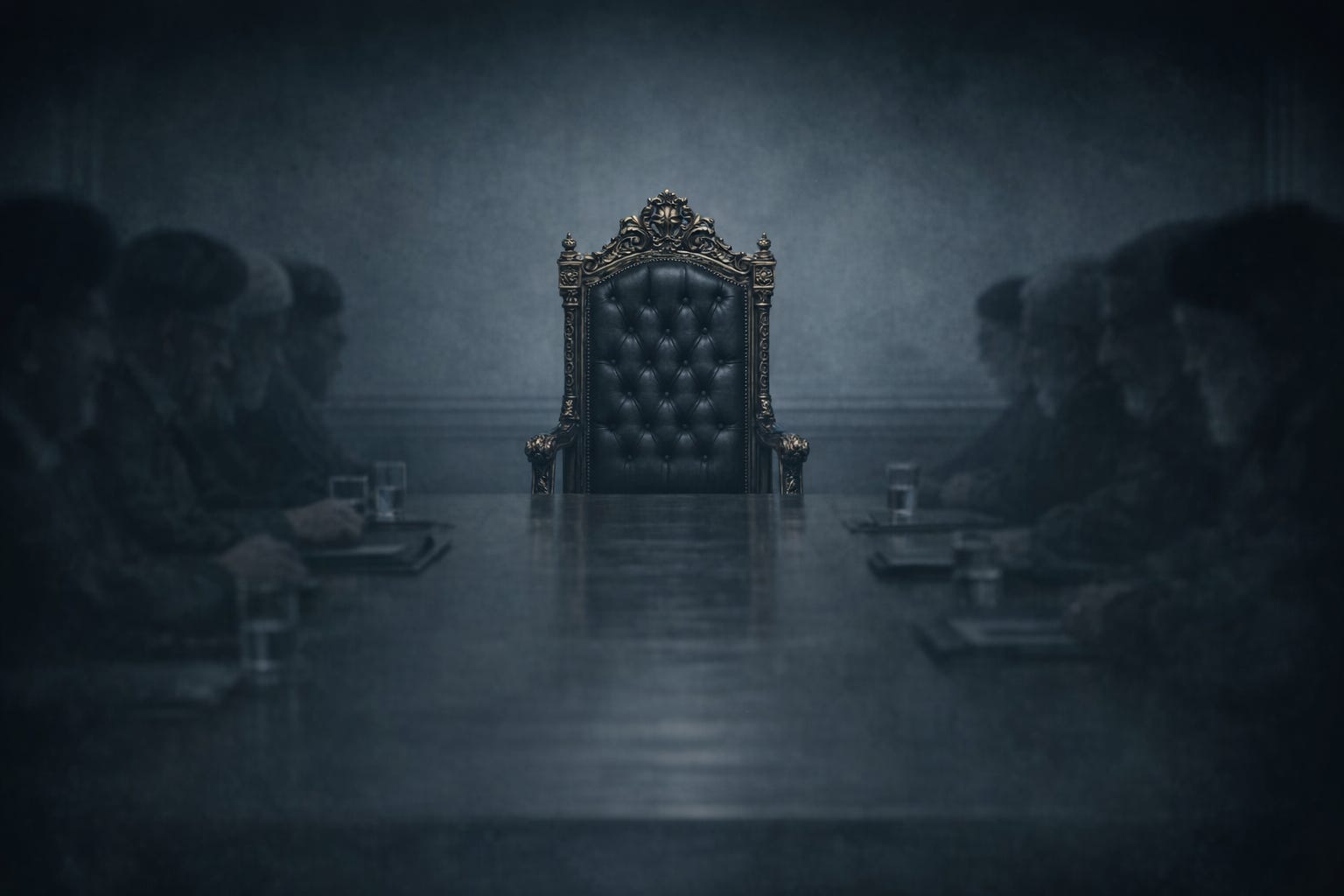
When I wrote last week that Iran’s leadership vacuum was better described as frozen than split, the evidence was doctrinal – the theological architecture of velayat-e motlaqeh faqih places authority in the office rather than the person, and no faction can assume it informally regardless of institutional weight. The reporting since then has sharpened that picture in one important respect: frozen was the right diagnosis for the system, but missing is the right description of what the system has lost. Frozen implies latent capacity that could resume. Missing specifies what cannot currently function – the conversion mechanism that turned competing factional positions into settled decisions.
The conventional interpretation, stated most clearly by ISW (the Institute for the Study of War) in its April 22 assessment, is that Iranian decision-making is “fragmented and in disarray”, producing an inability to formulate or communicate a coherent negotiating position. Trump has made the same argument less carefully, calling the leadership “fractured”. An Iranian analyst at Tehran’s Center for Scientific Research and Middle East Strategic Studies told Al Jazeera that the divide between the IRGC and Iran’s diplomatic team was “plain to see”. These are not strawman positions. Abbas Araghchi (Iran’s Foreign Minister) announced the Strait would reopen to commercial shipping; the IRGC declared it closed again the next day. The Islamabad delegation returned to Tehran with its mandate revoked. Iran’s Supreme National Security Council (the body formally responsible for aligning military and civilian decision-making) was allegedly unable to coordinate the competing power centres. Whatever is happening inside Tehran, the signals reaching the outside world are incoherent.
The question is whether incoherent outputs mean bad information, and here the conventional interpretation goes wrong.
Ali Vaez of the International Crisis Group explained that factionalism was always the designed operating condition of the Islamic Republic; it was not a crisis response. Rather, it encompassed multiple power centres with overlapping authorities competing as a matter of institutional architecture. The supreme leader’s function under Ali Khamenei for 37 years was to arbitrate that competition – to hear competing institutional positions and produce a unified output. What the war has suspended is not the factionalism. It is the arbitration. The outputs are incoherent because the mechanism that converted competing inputs into settled decisions is currently absent, not because the inputs themselves are bad.
The standard assumption about opaque authoritarian systems is that bad news doesn’t travel upward. It is the assumption that makes the “disarray” framing feel intuitively right. Nobody tells the Shah the revolution has already happened in the streets while his ministers are filing reassuring reports. The name of the game is filtration: every piece of information passing upward gets processed through a single question, which is how this lands with the man at the top, and the incentive structure produces sanitised inputs by design.
The Iranian system largely inverts this. Competing institutional interests – the negotiating faction around Mohammad Bagher Ghalibaf (Speaker of Iran’s Parliament and former IRGC general) and Araghchi; the hardline military command; the economic networks with their own calculations about sanctions relief – mean that bad news about any faction’s position surfaces routinely, because rival factions actively surface it. The IRGC needs to know what its air defences can actually do. The negotiating faction needs to know what the economy can actually sustain. The hardliners need to know what the pragmatists are conceding. None of them can operate on flattering information, because their institutional survival depends on accurate threat assessment in a way that a courtier’s survival does not require. Competitive intelligence is a byproduct of internal competition rather than institutional virtue, but it is competitive intelligence nonetheless.
Trump’s information environment runs the other way. Witkoff and Kushner are managing a relationship with a single principal – and have their own incentives to manage it optimistically – which means information passing upward gets filtered through the question of how it lands with the boss. His claim that he doesn’t know who is in charge in Iran is probably accurate, but his own information environment is not constructed to tell him, and Washington’s information problem is as much the issue as Tehran’s.
Therefore the weaker party in this negotiation may well have a more accurate picture of the actual balance of costs and capabilities than the stronger one. This is not unprecedented – it was arguably true of the Vietnamese across multiple negotiating rounds with the Americans – and it creates inherent instability, because a deal that one side understands better than the other tends not to hold.
Sanam Vakil of Chatham House observed that Mojtaba Khamenei is regularly presented with faits accomplis. This goes beyond his physical incapacity, though the reports of severe injuries, multiple surgeries, and the impossibility of electronic communication make real-time arbitration virtually impossible. The IRGC is operating on a tactical loop that the courier system – handwritten letters, sealed, carried by human chain to his hiding place and back – cannot keep pace with. By the time a reply returns, the operational window has closed. The arbiter is not absent in the way that a vacant chair is absent; he is present but systematically bypassed by the pace of events, which is worse, because it lends legitimacy to decisions he has no practical ability to influence.
Karim Sadjadpour of the Carnegie Endowment for International Peace distilled the deadlock to a sentence: there are people who want peace but have no power to bring it, and people who could bring peace but have no interest in doing so. The Islamabad round illustrated this conundrum. The New York Times documented a disagreement between Ghalibaf, who publicly defended negotiations as necessary, and the hardline IRGC command that opposed them. When the delegation returned to Tehran, its negotiating position was pulled from under it. Araghchi said they were “inches from a memorandum of understanding”. That is probably true, and it is exactly what alarmed the faction with the authority to stop it, because the closer a deal came to existing, the more the internal veto-players were forced to act.
The face-saving problem on both sides is often treated as the central obstacle. Yet, it is solvable in principle: symmetrical face-saving constraints are a question of sequencing and packaging – selling a plausible story – and diplomacy has navigated that kind of constraint before. The harder problem is that packaging a deal requires someone on the Iranian side who can authorise a position and hold it through the process.
Factions can signal. They cannot commit.
Whether Mojtaba Khamenei recovers sufficiently to perform the arbitration function, or whether the system develops another mechanism for producing unified outputs, will determine whether there is a deal at all. The economic logic for a deal is compelling – an economy already under severe strain before the war, a blockade tightening the screws further – and survival instinct can dissolve institutional rigidity. But survival instinct still has to flow through some decision-making mechanism to produce a signed outcome. Right now, that mechanism is missing.