
Maybe This Time. Maybe Not.
Talks are on again, but the emerging Hormuz proposal shows why ending the war remains so difficult

So where are we now? The short version is that Iran and Oman appear to have agreed on where ships could travel through the Strait of Hormuz, but almost nothing has been publicly agreed about the conditions under which they would travel.
Early in the week, it sounded as though a deal might be announced almost immediately. US Treasury Secretary Scott Bessent said Hormuz could reopen within a day or two, Trump said negotiations were moving along nicely, and Qatar confirmed that indirect US-Iran talks had reached “very progressive stages”, with draft language being circulated between the parties. Unsurprisingly, oil responded accordingly as traders unquestioningly accepted these assurances yet again, with Brent falling below $80 a barrel and WTI down near $75.
Then – like “déjà vu all over again” – the proposed terms began to emerge.
Iran and Oman appear to have agreed on the coordinates of a temporary route through the strait, whereby vessels entering the Persian Gulf would travel through Iranian waters under Iranian management and those leaving would initially use mostly Omani waters. Later Iranian accounts amended the latter to describe outbound traffic as being jointly overseen by Iran and Oman. Eventually, both existing routes would be replaced by a central corridor administered under the new arrangement. This temporary route is to operate while negotiations continued over a permanent settlement. The initial period seems to be 60 days, although Iranian officials have suggested it could continue for as long as four months. Iran is also reportedly considering allowing European countries to clear mines from the waterway, which would provide shipowners and insurers with at least some assurance that it was safe.
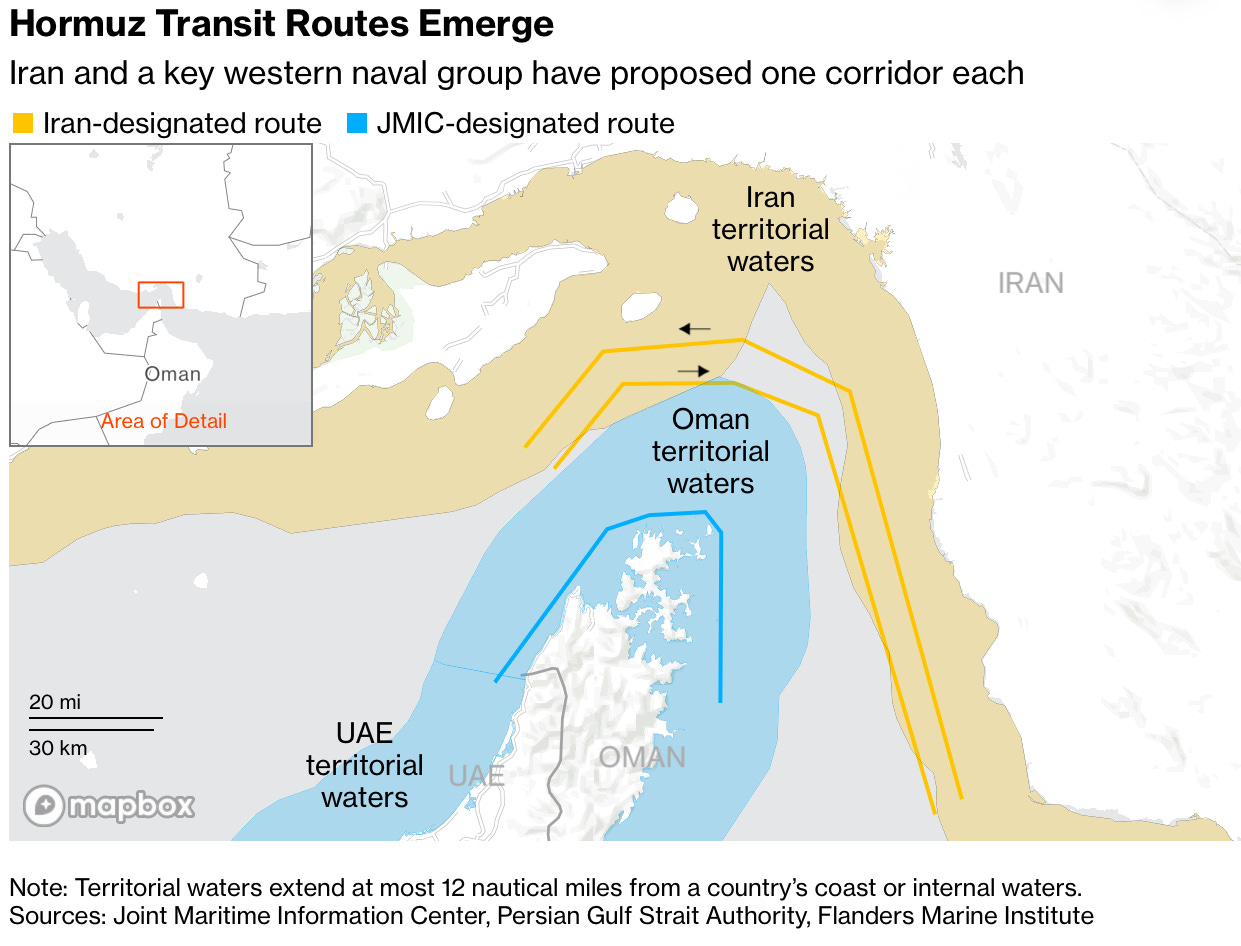
Now all of that sounds quite practical, which is somewhat unusual for these negotiations. After months of competing American and Iranian routes, ships would have one agreed channel and a common process for moving through it. The ambiguity over navigation that helped destroy the June ceasefire would finally be resolved. Except the route is the easy part. The dispute is over who controls it, who may use it and whether Iran can charge for passage.
Iran wants to bar US and Israeli vessels, restrict cargo linked to Israel, require compensation from countries it considers responsible for the war and charge for services associated with transit. Reports state that Iran is seeking fees equal to 5-7% of cargo value, while Oman has considered a charge of around 3%. These are not modest port or pilotage fees. A VLCC carrying $150 million of crude would face an Iranian charge of $7.5 to 10.5 million. Additionally, payments to Iran’s Persian Gulf Strait Authority could breach US sanctions, exposing shipowners, banks and other intermediaries to penalties or frozen assets. New Lloyd’s Market Association clauses apparently terminate cover if a vessel pays the disputed fees. A tanker owner, therefore, would face the risk of complying with Iranian rules, violating American sanctions and losing insurance coverage. Clearly that is not a workable basis for commercial shipping.
Unsurprisingly Washington has rejected this entire concept. A US official said on Thursday that any temporary route must operate without approvals, permissions, tolls or charges. The US wants a return to something resembling the pre-war position, under which Hormuz was treated as a waterway open to international shipping rather than one administered by Iran.
The situation is therefore that Iran and Oman appear to have agreed on a route, but the terms Tehran attaches to it remain unacceptable to Washington and potentially unworkable for commercial vessels. So, in other words, we remain at an impasse over the same issues, and the market wearily moved Brent back up to $83.55 and WTI to $78.18.
Iran is not offering the old Hormuz back
The easiest way to misunderstand these talks is to assume that Iran is negotiating the reopening of the pre-war Strait of Hormuz, but it is not. Tehran is offering a new arrangement built around the leverage it has acquired during the war; managing ships entering the Persian Gulf, retaining visibility or joint authority over ships leaving, excluding vessels or cargo it considers hostile, and receiving compensation or fees for allowing passage. One person familiar with the talks told Reuters that the concession has already been made on some form of Iranian control over the strait, whatever form the final language takes, so Washington accepting Iranian control without acknowledging it explicitly appears to be the likely outcome here.
Iranian legislators are considering a bill that would ban US and Israeli ships, restrict cargo connected with countries supporting Israel and fine violators as much as 20% of cargo value. The legislation may never take effect and is probably intended partly to strengthen Iran’s bargaining position, but it reveals how Tehran now views Hormuz. More than just as a waterway beside its coast, it is an instrument through which it can regulate the economic relationships of other countries.
The US position is almost the reverse. It insists that Iran has no right to decide which commercial vessels may transit an international strait and no right to charge them. Any formal recognition of Iranian control would, Washington argues, undermine freedom of navigation and establish a precedent that could be applied at other maritime chokepoints. Yet, as has been clear for months, the superpower does not have the sway it thought it had. This is why what had looked like a promising agreement may be another false dawn. Agreeing the route coordinates is not the same as agreeing to reopen. Iran and Oman have apparently decided where a ship can sail, but the US and Iran have not decided what sailing through that route would mean.
The discussions are raising more questions than they answer. Would a transiting vessel need explicit Iranian permission? Could Iran inspect its ownership or destination? Could it prohibit cargo bound for Israel? Would shipowners pay Iran, Oman or a jointly administered body? Would the US waive sanctions on those payments? Would insurers continue covering the vessel? And what happens when Iran classifies a ship as hostile but Oman does not? Until those and other questions are answered, the central corridor is simply a line on a chart rather than an open trade route.
The price of reopening is lifting the blockade
The other essential part of any agreement is the US blockade of Iranian ports. Iran has not promised that agreement with Oman would automatically reopen Hormuz – it is a necessary but not sufficient requirement. Tehran says the US naval blockade of Iranian ports must first be lifted. CENTCOM has interdicted or redirected dozens of ships since restoring the blockade in July, preventing Iran from moving its oil and other trade while insisting that Iran allow everybody else’s cargo through the strait. From Iran’s perspective, reopening Hormuz while its ports remain blockaded would amount to surrendering its principal leverage for nothing. It would restore the oil exports of US partners, relieve pressure on the global economy and reduce the political cost of the war for Trump while leaving Iran economically strangled. Obviously not a trade Tehran has any reason to accept.
The June Memorandum of Understanding (MOU) explicitly recognised this connection. The US agreed to lift the blockade, restore waivers for Iranian oil exports and begin releasing frozen Iranian assets, while Iran agreed to permit free passage through Hormuz and maintain the nuclear status quo during a 60-day negotiating period. That MOU broke down, however, because the sections dealing with Hormuz were too vague. Washington believed ships could use the southern route without Iranian involvement while Tehran continued to insist that vessels follow authorised channels and accept some Iranian oversight. Ships were attacked, the US resumed strikes and sanctions, and the blockade was reimposed. This is a recognised problem with attempting to negotiate international agreements in brief and in a hurry. It is well known in diplomatic circles that such documents are complex and liable to misinterpretation, especially if they are in more than one language. This is why they normally take months or even years to finalise, and frequently run to dozens or hundreds of pages. The MOU attempted to compress a ceasefire, blockade relief, maritime administration, sanctions waivers, nuclear restraint and a pathway to a permanent settlement into just 14 brief points, while leaving the most disputed operational terms undefined. It was more an agenda for further negotiation than an agreement, so had little chance of lasting.
Washington had previously not indicated that it was willing to restore the other half of the June bargain, but that possibly changed on Friday. A US official said Washington expected an Iran-Oman agreement to be announced soon and would lift its blockade of Iranian ports if Iran then provided unimpeded commercial passage through Hormuz. This is the first clear indication that the Oman route could become part of another US-Iran ceasefire rather than remain a bilateral arrangement that Washington rejects, because it provides the necessary exchange whereby Iran restores commercial passage and the US removes the blockade. Yet the sequencing problem remains. Washington says lifting the blockade will be “performance-based” and conditional on Iran implementing the agreement. Iran has maintained that it cannot fully reopen Hormuz while its ports remain blockaded. The US therefore wants Iran to surrender its principal leverage first and promises relief once it is satisfied with Iranian performance. Tehran wants the blockade lifted as part of the opening itself. And still the devil remains in the detail. The parties have not publicly agreed on what unimpeded passage actually means. For Washington, it means no Iranian permissions, discriminatory restrictions or tolls. For Tehran, the emerging arrangement appears to preserve Iranian management of inbound traffic, restrictions on hostile vessels, and charges for maritime services.
Are the US and Iran negotiating?
There are negotiations between Iran and the US, but not in the way Trump has implied. Iran initially insisted that it was holding talks only with Oman. Trump responded by calling the Iranian leadership “unbelievably duplicitous”, claiming that Tehran had requested negotiations while publicly denying they existed. Qatar subsequently confirmed that indirect US-Iran talks were under way and that draft language was circulating. Qatar and Pakistan are reportedly working with Oman, while Saudi Arabia and Iraq have also carried messages and pressed the parties to avoid another escalation. So there is an active diplomatic process, but apparently no direct negotiation between American and Iranian officials. Messages are moving through several intermediaries, allowing Iran to talk to Washington through backchannels without publicly appearing to negotiate while under bombardment and blockade.
This is more than a semantic distinction or simple posturing. Iran needs to present any agreement as the product of regional diplomacy rather than capitulation to American threats. Trump, meanwhile, needs to present it as a deal he personally imposed upon Iran. The art of successful negotiation, especially in the diplomatic arena, is to arrive at a position such that both sides can present their preferred – yet, ostensibly mutually exclusive – cases to their respective audiences at home while coming to an agreement through compromise. This requires understanding your opponent intimately, a failing that the US has demonstrated numerous times over the years, especially with respect to Iran.
Whether Iran can approve a final document at all is a separate obstacle. Any agreement would require the consent of Supreme Leader Mojtaba Khamenei, who has remained in hiding since being injured during the initial US-Israeli attacks, and President Masoud Pezeshkian says communication with him is currently “very difficult”. The diplomats may therefore be circulating language without knowing whether Iran’s ultimate decision-maker has accepted it, or will do so. That is a more realistic and meaningful obstacle than JD Vance’s convenient and simplistic division of the Iranian state into people who want peace and “crazy radicals” who do not.
The US has run out of useful military options
Trump keeps threatening enormous attacks and then postponing them. This is partly posturing and partly a recognition that he is now aware that he has limited military options. The US has demonstrated that it can destroy Iranian civilian and military infrastructure on a huge scale. It has reportedly struck more than 13,000 targets, damaging air bases, missile sites, ports, industrial facilities and government buildings. Iran’s economy has suffered losses measured in the hundreds of billions of dollars, inflation has surged and perhaps a fifth of its industrial base has been damaged. Yet the bombing has not forced Iran to capitulate or even to reopen Hormuz. The historical record offers little support for the idea that bombing alone reliably forces a determined state to surrender. NATO’s 1999 campaign in Yugoslavia is the closest modern example, but even there the outcome followed 78 days of bombing alongside Russian diplomatic pressure, growing isolation and a credible threat of ground intervention. Iran is much larger, retains greater retaliatory capacity and is fighting over what its leadership regards as an existential issue.
On the naval front, Iran does not need to defeat the US Navy in a conventional battle. It needs only to retain enough missiles, drones, mines and small boats to make a few tanker owners believe that their vessels may be hit. Trump acknowledged this himself on Thursday: the US may claim to control the waterway, but Iran “can always shoot something”, and owners do not want to risk valuable ships. That sums up the whole war, and why a short “excursion” has turned into a 5-month stalemate. Military control of the sea is not the same as commercially reliable passage through it. Even with a navy not totally suited to the task, the US can still escort ships, patrol the Omani route and strike Iranian launch sites, but it cannot guarantee that a tanker will not hit a mine or be attacked from the Iranian coast. If crews refuse to sail, insurers withdraw cover and shipowners keep vessels outside the Gulf, then any declarations of American control have little practical value. ADNOC, the UAE’s national oil company spent $1.3 billion this week to nearly double its VLCC fleet from eight to fourteen, bringing more of the transport chain under its own control, although this does not remove the underlying missile, mine and insurance risks.
It was reported that a senior officer in CENTCOM’s intelligence branch emailed a broad group of military analysts asking for “new creative and unconventional ways to pressure and punish Iran”. This is revealing as it shows that after five months of fighting, the military is out of ideas and looking for new ones because further iterations of the existing campaign will not produce the result Washington wants. Trump’s recent threat of the “largest attack since the Second World War” was withdrawn after Gulf leaders urged him to negotiate. Reports that shortages of missiles and air-defence systems influenced the decision have been angrily denied by Trump, even as the Washington Post reported he privately confronted Defense Secretary Pete Hegseth over having been misled about the state of those stocks. Regardless of the denial, it remains a fact that the heavy depletion of interceptor stocks is a significant problem, especially while Iran retains enough inexpensive offensive weapons to continue imposing costs. Although the US can inflict much greater destruction, Iran has nevertheless retained the cheaper path to achieving its immediate objective. It is reminiscent of past American wars, like Vietnam.
Iran is paying dearly too
Of course, none of the above means that Iran is winning without incurring meaningful costs. Its military and industrial infrastructure has been badly damaged. The rial has fallen, inflation has risen dramatically, unemployment has increased and the naval blockade is choking trade. Estimates of total losses vary enormously, but even the lower figures are severe. Rebuilding the petrochemical complexes at Mahshahr and Assaluyeh could take more than decade. Pezeshkian has described the country as facing its most difficult period since the Islamic Revolution. A permanent war economy built around shadow shipping and retaliation is not a viable development strategy, so Iran will eventually need foreign currency from oil exports, access to its frozen assets and a credible route towards reconstruction.
Yet suffering does not automatically produce surrender. Iran has lived under Western sanctions for decades, has developed methods of evading them and can make the consequences of its economic hardships felt far beyond its borders. More importantly, foreign attack also strengthens the hardliners’ argument that compromise with Washington is impossible and encourages at least some Iranians who had been opposing the Government to rally around the country against an external aggressor. Iran’s long history of foreign intervention gives that response deep political resonance.
Strategy and the Countdown Clocks
The strategic question is therefore not whether Iran is being hurt, since it obviously is. The question is whether the pain being inflicted changes Iranian decisions before its retaliation changes American decisions. So far, it has not.
It is a contest between two clocks. One clock measures Iran’s economic deterioration. The blockade is suppressing exports, industrial damage is accumulating and the cost of eventual reconstruction rises every day. The other clock measures the depletion of the world’s ability to absorb the disruption: commercial inventories, strategic reserves, missile interceptors, political patience and household tolerance for higher fuel prices. Iran is suffering more in absolute terms, but Trump faces the shorter political timetable. The US midterm elections are in November, petrol prices remain well above their pre-war level, and the administration needs lower energy prices quickly. Iran does not need a healthy economy by November – it needs only to avoid capitulating before the political cost becomes unacceptable in Washington.
The brief June ceasefire made that contest still more difficult for the US. Iran received temporary sanctions relief and used the window to export stored oil and generate several billion dollars in foreign currency. Oil prices fell, encouraging the US to believe that the crisis had passed, but global inventories and strategic reserves did not fully recover. When fighting resumed, Iran entered the next round with some additional funds while the global buffer remained thin. The threat of more bombing is less persuasive than it may appear. Iran knows that another major escalation would send oil prices higher, accelerate inventory depletion and hurt Trump before it necessarily forces Tehran to concede.
The clock does not have to run out completely. It only has to convince Trump that accepting an unattractive agreement is preferable to continuing the war. And that is what you would expect – Iranian patience outlasting that of the West. An authoritarian regime and patriotic populace facing an existential threat against liberal democracies undertaking a war of choice. Iran’s leadership can suppress dissent, absorb severe domestic hardship and portray the war as resistance to an existential foreign attack. Trump, by contrast, is fighting a discretionary war while facing elections, higher fuel prices and declining public support. The two clocks are not running at the same pace.
The war is no longer confined to Hormuz
The opening of a second maritime front has made that determination more urgent. Saudi Arabia had responded to the closure of Hormuz by sending more crude through its East-West pipeline to Yanbu on the Red Sea, but the Houthis have now declared a blockade of Saudi ports, attacked tankers and Aramco facilities, and expanded their strikes against Saudi-aligned forces in Yemen. Riyadh is trying to contain the escalation through Omani mediation rather than return to the unsuccessful bombing campaign it conducted in Yemen before the 2022 truce. The US is also discouraging a major Saudi response because widening the conflict around Bab el-Mandeb would threaten the remaining alternative route for Gulf oil.
Regional security arrangements are adjusting under the same pressure, separately from anything involving Hormuz directly. Saudi Arabia, Turkey and Pakistan signed a mutual defence pact in Mecca on Friday, agreeing that an attack on any one of the three would be treated as an attack on all three. It is difficult to view that without reference to the context of the past five months during which US security guarantees in the region have looked less reliable than they did pre-war. Three major regional powers choosing to underwrite each other’s security while Washington negotiates the end of its war certainly appears to reflect the diminished sway Washington still has left.
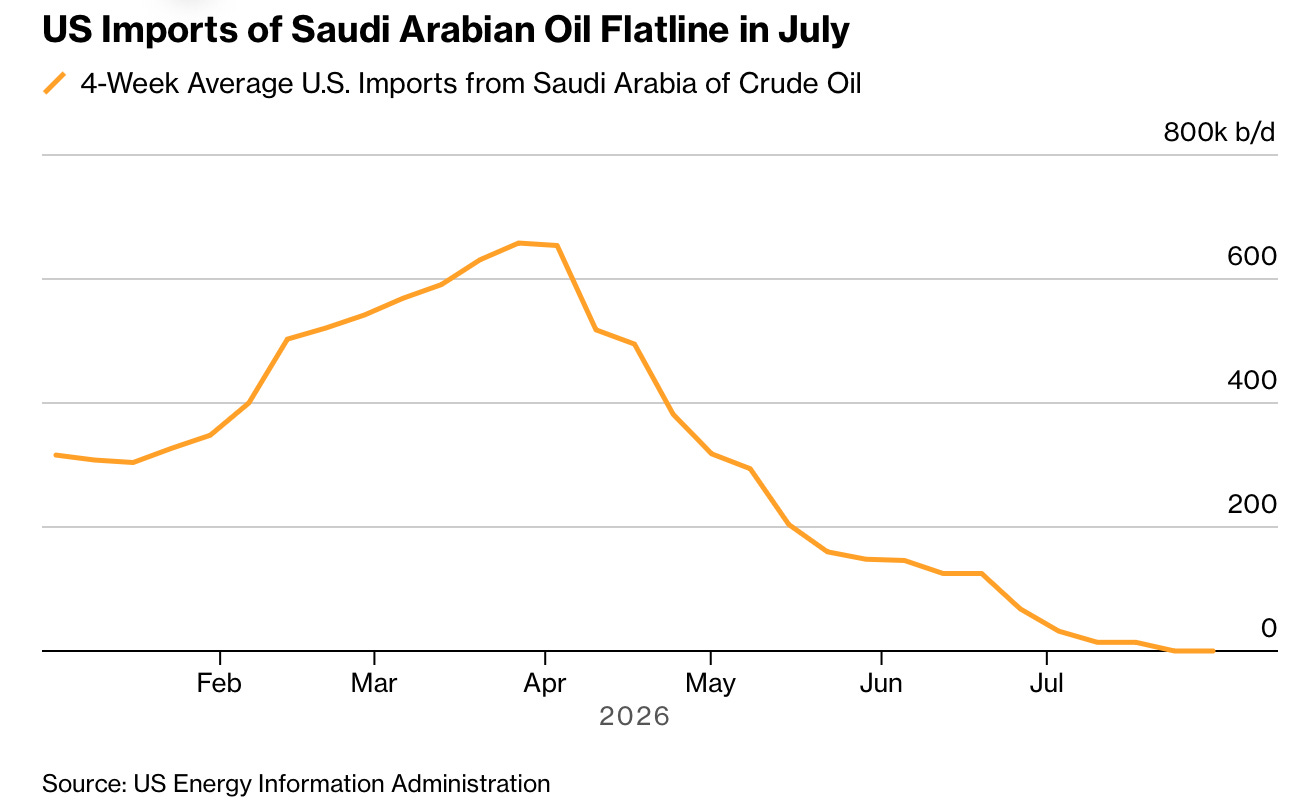
Some Saudi crude is still leaving through Yanbu. Tankers have crossed Bab el-Mandeb with their transponders switched off, while others have travelled north through Suez or taken the longer route around Africa. However, these movements are irregular, expensive and exposed to further Houthi attacks. The disruption is visible in trade flow data, with US imports of Saudi crude falling to zero for the entire month of July – the first month without a Saudi delivery since 1985 – after exceeding 0.8 mb/d earlier in the year. American refiners have substituted domestic light crude and Venezuelan barrels where possible, despite differences in crude quality and refinery configuration. Although US imports from the region may rise again in August as cargoes loaded during the June reopening finally arrive and Saudi barrels are redirected through Yanbu and Suez, that still does not change what July demonstrated.
Traffic has fallen further while the parties negotiate. Only 33 commodity vessels crossed Hormuz between Monday and Thursday, down from 50 over the same period a week earlier and around 130-140 a week before the war. Only four vessels in total crossed on Thursday. More importantly, 21 crude tankers entered the Gulf during the week, but only six exited. That imbalance suggests that Iran is continuing to allow vessels into the Gulf but restricting their departure.
Iran has also warned Gulf Governments that their oil fields, refineries, electricity grids, water infrastructure and transport networks could be attacked if they fail to persuade Trump to end US strikes. That places Saudi Arabia, Qatar, the UAE and other US partners in an impossible position. They depend upon American security support, but American escalation makes them the most accessible targets for Iranian retaliation. Their pressure on Trump to cancel the planned attack indicates that they increasingly regard continued US escalation as a threat to their security.
The oil market believed the headline… again
The movement in oil prices over the past week shows a paradoxical situation, illustrating both a wilful disregard of the fundamentals – preferring to believe a solution is nigh and oil prices will fall – then suddenly switching to a demonstrated lack of confidence in the process as oil prices rise again. Brent fell below $80 when Bessent suggested that an agreement could reopen Hormuz within days. However, once the Iranian terms became clearer and reports emerged of Iranian strikes on targets described as hostile near Qeshm Island, it rose almost 4% in a single session and then continued above $83.
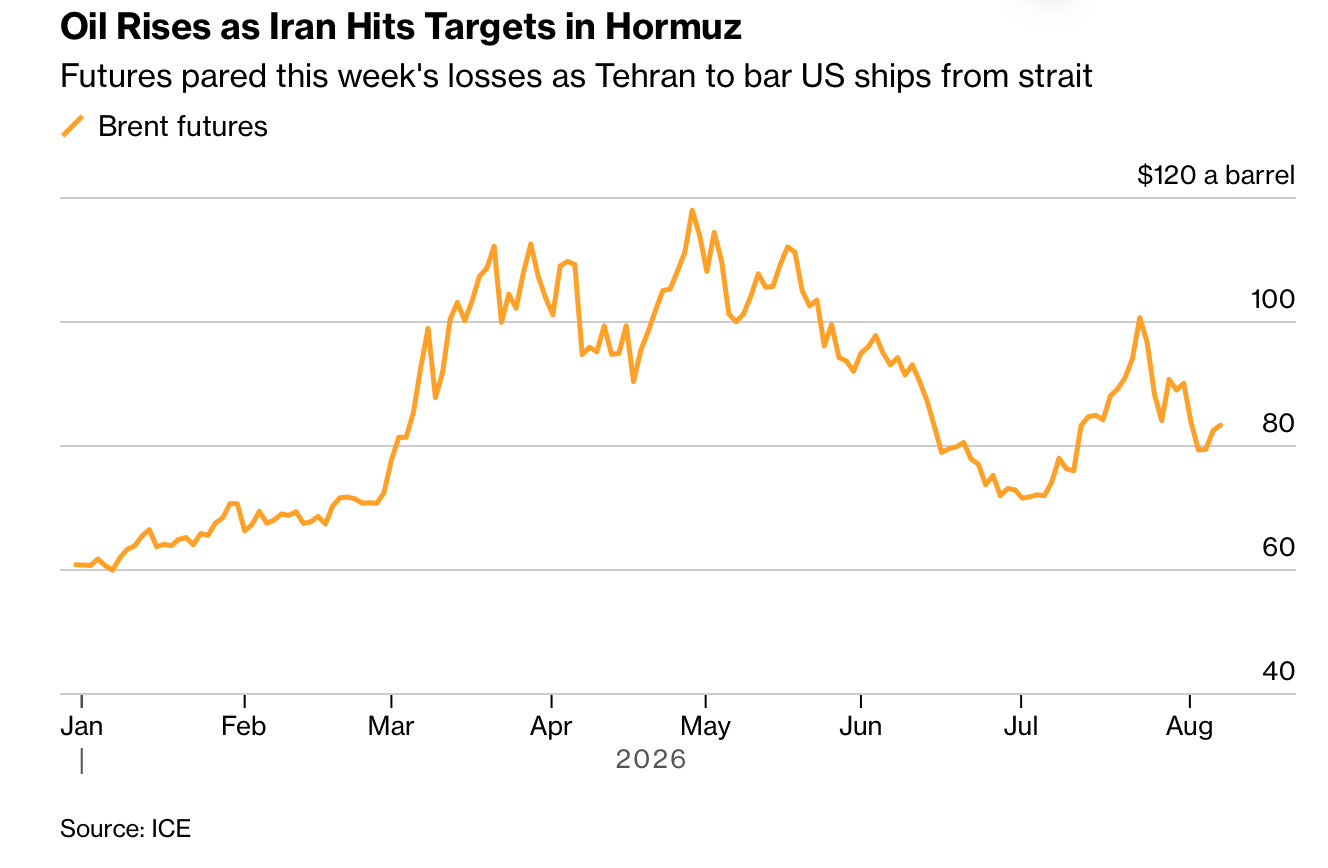
The futures price, too, should not be mistaken for a complete measure of the shortage. Prompt physical crude has continued trading above the paper benchmark because refiners must pay for barrels that can actually be delivered to them, not futures contracts reflecting expectations about a possible agreement. A fall in Brent on optimistic headlines does not result in stranded Gulf barrels suddenly appearing at a refinery. The same issue applies to any reopening. A diplomatic announcement will produce an immediate fall in futures, but restoring physical supply will require mine clearance, sanctions waivers, insurance, willing crews, available tankers and evidence that the arrangement will last past its first disputed transit. Even a fully signed agreement would therefore restore the roughly 20 mb/d pre-war flow only gradually rather than overnight.
What would an actual agreement require?
At this point the terms needed for agreement are reasonably obvious, however difficult it may be for either side to admit. Iran would have to stop attacking commercial shipping, abandon discriminatory restrictions on cargo, accept a meaningful limit on its ability to obstruct passage, and maintain the existing freeze on its nuclear programme. The US would have to end its attacks, lift the naval blockade, restore authorisation for Iranian oil exports, waive sanctions on whatever administrative mechanism manages the strait, and provide access to at least some frozen Iranian assets. The June MOU already contained most of this bargain, but lacked clarity and detail, so the current talks are predominantly about trying to make the old agreement operational and politically presentable.
Washington has now offered to lift the blockade if Iran first provides unimpeded passage, so the outlines of another temporary agreement finally exist. Yet, the same questions which destroyed the June MOU remain unresolved: who moves first, what constitutes free passage, and how much authority Iran retains. Washington means passage without permissions, discrimination or tolls, and Tehran wants its management role recognised and the ability to restrict hostile vessels and charge for services. Both sides also need to claim victory. Trump wants to say that military pressure reopened Hormuz and froze Iran’s nuclear programme. Tehran wants to say that it survived the assault, ended the blockade, restored its oil exports and secured recognition of its role in the strait. A regional management arrangement may contain enough ambiguity for both accounts, although that same ambiguity could cause it to unravel at the first disputed transit.
There is already a precedent for that dynamic breaking a deal rather than completing one. The first round of high-profile talks after the June MOU was signed fell apart because Trump took offence at comparisons between the MOU’s terms and Obama’s 2015 nuclear deal. He threatened to attack Iran and take it over, and the Iranian delegation walked out. The need to look like the side that won has already wrecked one round of this negotiation, and nothing about the current fee dispute makes that need any smaller.
The available settlement is therefore much narrower than the outcome Trump promised when he began the war. Further bombing would damage Iran but would not remove its ability to disrupt Hormuz. Instead, it would provoke more attacks, raise energy costs and leave the same negotiation waiting at the end. The war has reduced America’s objective from forcing Iranian capitulation to finding a tolerable description of compromise. An agreement now depends upon whether Trump can accept that result – and continue accepting it once his critics describe it accurately.
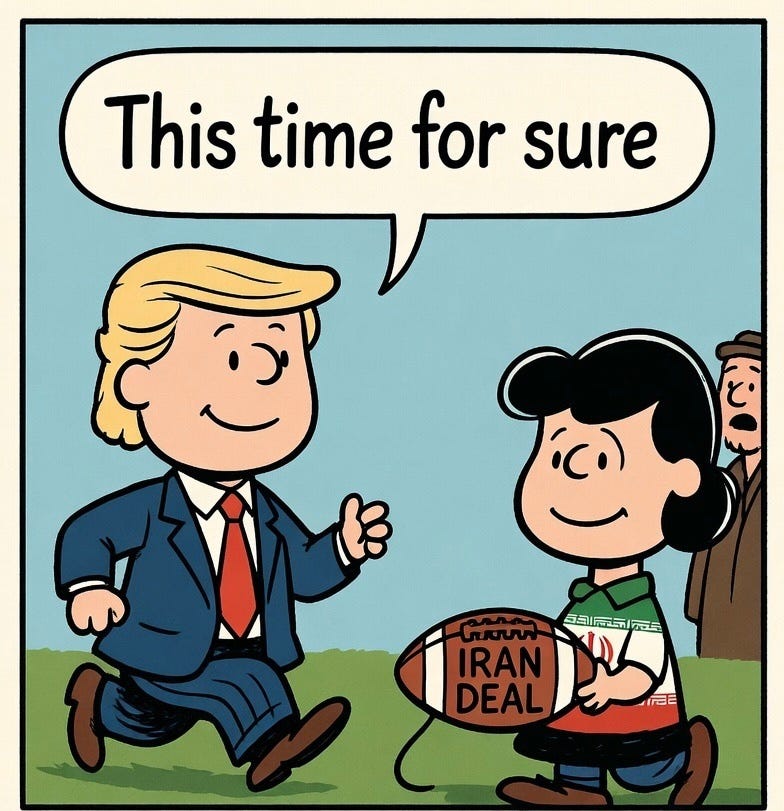
What’s the over/under on number of days this Iran & Oman agreement lasts