
Fighting the Enemy That Never Existed
Part 2 of a triptych on US foreign policy

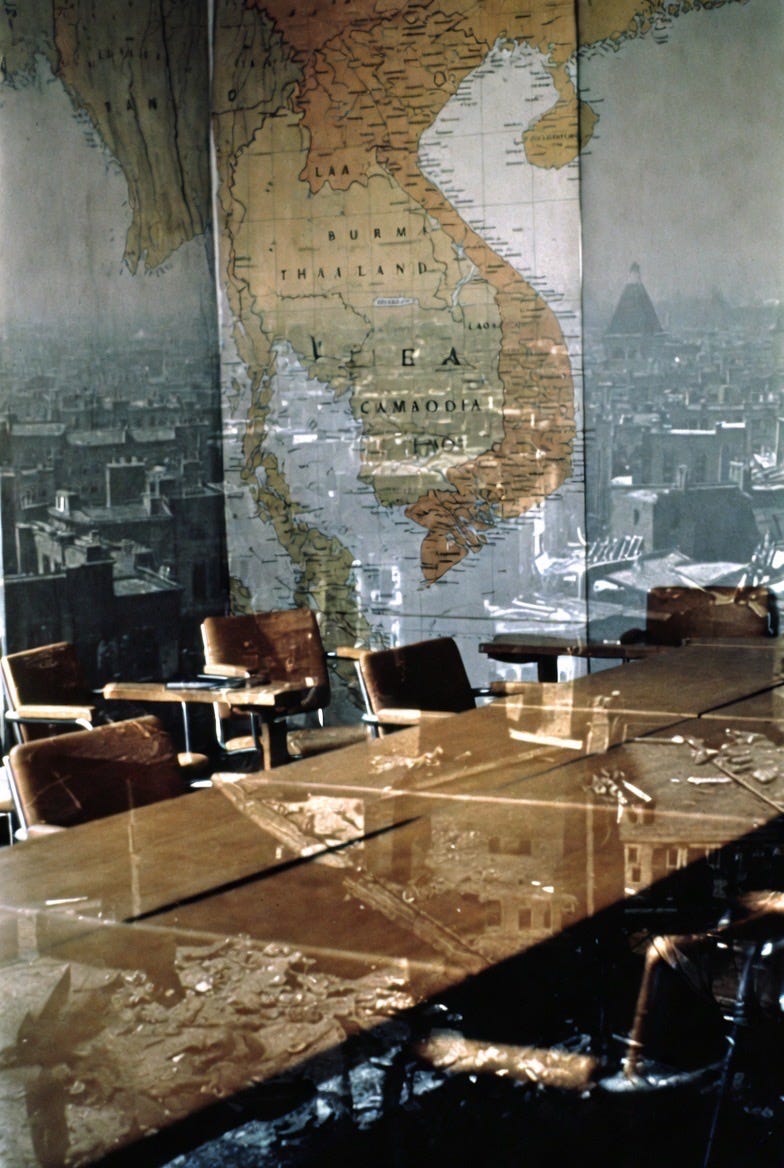
In A Bright Shining Lie, Neil Sheehan considers something that should have been obvious but never quite was.
Despite the evidence of Tito’s behavior, they could not believe that a Communist leader might have as his basic goal the independence of his country. They helped Tito, but they were never comfortable with him and thought of him as an aberration. Part of the explanation for their failure to take seriously the existence of national Communism (and to perceive that Stalin, monster though he was and responsible for the deaths of millions in the Soviet Union, was in his foreign policy a Russian imperial statesman with limited goals) seems to lie in the fact that they did not want to see the world as a complicated place. If Tito and Ho and Mao Tse-tung were nationalists as well as Communists, if differing cultures and histories might lead Communist nations to develop along distinct lines, then the world was far more complex than these American leaders imagined it to be. Their own inclinations were easier to follow in a simple Manichaean world of Good and Evil.
That observation from Sheehan never really aged. If anything, it became a recurring diagnostic.
The United States has a habit of seeing its enemies as monoliths, not alliances or coalitions of convenience, or overlapping yet conflicting projects, but singular forces moving with internal coherence and shared intent. Once an enemy is defined that way, the rest follows naturally: scale and escalation become substitutes for strategy and understanding. Politics is subsumed into military effort rather than the other way around.
The pattern emerged from the circumstances described in the first essay –not from confusion but from conviction. That is, the conviction that order was fragile, credibility was perishable, and local instability could cascade into systemic collapse. That perspective made treating enemies as unified blocs feel not just convenient but necessary. If the threat was everywhere, responses had to be general. If retreat anywhere meant weakness everywhere, discrimination looked like risk.
The problem was not the approach itself, but how it hardened into habit. What began as a response to lived trauma became an institutional reflex that persisted long after the conditions that produced it had changed.
How the pattern reproduced itself
During the Cold War, this took the form of treating communism as a single, centrally animated project. The Soviet Union, China, Vietnam, Cuba, Angola – these were rendered as expressions of one threat rather than actors pursuing distinct, often incompatible goals.
Josip Broz Tito was a warning, not an aberration. So was Ho Chi Minh, whose communism sat comfortably alongside a much older and deeper nationalism. So, in a different register, was Mao Zedong, whose relationship with Moscow oscillated between cooperation, suspicion, and eventual rupture. None of this actually required hindsight, but instead accepting that ideology did not dissolve history, and that alliances formed under pressure did not erase underlying divergence.
But acknowledging that meant abandoning the idea of a single enemy. Once that idea was gone, so too was the intellectual justification for treating every local conflict as a front in a global war.
Vietnam is the obvious case, not because it was unique, but because it was typical. A nationalist struggle against colonial inheritance was interpreted as a node in a communist offensive, and the response followed accordingly. What might have been managed politically was prosecuted militarily, at scale, for years, with objectives that altered but always lacked focus. The war did not end because it could not end within the logic as defined. There was no unified enemy whose defeat would resolve the problem.
Following the disappearance of the Soviet Union, this way of seeing was repackaged.
After 2001, the United States declared war on terror – not on an organisation, not on a state, not even on a specific network, but on a category. Terrorism became a stand-in for an enemy presumed to be unified, adaptive, and globally coordinated, even when the actors involved shared little beyond grievance and opportunism.
Al-Qaeda, the Taliban, sectarian militias, local insurgents, criminal networks, regional power brokers – these were shrunk into a single adversary, as if motive, geography, and political ambition were details rather than drivers. The result was a conflict architecture unable to discriminate between enemies because it no longer recognised them as discrete.
Tactics improved and technology advanced, but the wars themselves drifted. Wars against abstractions do not conclude, instead persisting until exhaustion sets in, or until attention moves elsewhere.
Why simplification becomes institutional
The pattern institutionalises analytical laziness rather than reflecting moral failure or lack of capacity.
Seeing the world as a contest between blocs relieves decision-makers of the burden of judgement. If the enemy is unified, then nuance looks like weakness. Negotiation becomes appeasement, local politics is noise, and violence is the only language worth translating.
This is why the pattern has reproduced itself across decades and different conflicts. The pattern generated its own validation by interpreting every new threat through categories that already existed. Evidence suggesting fragmentation, competing interests, or local drivers was absorbed as tactical detail rather than strategic reality.
Institutions cannot correct this easily because it serves institutional needs. It simplifies planning and justifies budgets, while complexity creates friction, demanding a choice over which conflicts can be tolerated and which must be crushed. It requires acknowledging that not every opponent shares the same goals, and that defeating one may empower another.
It also means accepting limits. Nationalists do not surrender because an ideology is discredited, and movements rooted in local legitimacy do not dissolve when external patrons withdraw. Wars fought against ideas tend to expand rather than contract, because ideas do not sign peace treaties.
The irony is that American power is often most effective when it recognises fragmentation rather than unity, when it treats adversaries as political actors rather than avatars of a single menace. But that requires abandoning the comfort of the monolith.
The framework persisted because it was coherent
The simplification was institutional, not random. It was embedded in how institutions processed information and justified decisions, and that made it durable. Even when individual leaders recognised the limitations, the machinery around them continued to operate as if the old categories still applied.
Vietnam persisted because the logic made stopping harder than continuing. The War on Terror persisted for the same reason. Both were fought within a logic that interpreted evidence of failure as reason for escalation rather than reconsideration.
Yet this was still a framework. It was wrong, it produced disasters, and it subordinated reality to theory, but it operated within assumptions about credibility, alliances, and systemic order that imposed some discipline on how power was used. Decisions had to be explained, coalitions assembled, and objectives articulated. Much of this was theatre, but theatre creates drag. It forces process, and process imposes limits.
That framework has now collapsed, not because it was reformed or corrected, but because it was abandoned. What follows now is not a better theory or a more sophisticated analysis. It is the exercise of power without the organising logic that once constrained it, however inadequately.
What I see looks a lot like malignant narcissism. A zero-sum view of the world and others, get them before they get you, a sense of a persistent existential threat, an odd combination of both an insecure victim mindset and a grandiose sense of being special and better than others.
The victim/threat/insecurity/danger justifies attacking others. Whatever narcissists do to others is always either justifiable defense of the person/country on the receiving end did something to deserve it.
Narcissists can do no wrong in their own mind and they are impervious to facts and logic that can call into question their high opinion of themselves or the necessity and righteousness of their actions.
They can go from one disaster to another their entire lives without ever questioning themselves, their choices, their actions. The problem is always someone or something else, external enemies.
The degree to which this is automatic and impervious to facts, evidence and reason, and the mayhem they cause in other people's lives is something one has to experience to understand. It defies at lot of what most people assume is true of all people in general, but most people are naive due to a lack of firsthand experience.
To me, this is the best model for what US foreign policy has become. We are running around the globe destroying and creating chaos while telling ourselves we are acting defensively and helping others.
With Iran even that seems to have broken down, mask off now it's almost pure: I'll take what I want, do as I want and you'll do as I say or I'll destroy you.
This is the motive that's always what's really underneath narcissism, but it's typically masked.
It would be easy to blame this on Trump. He fits that mold personally, but as you are documenting, he is an expression of Neocon foreign policy, not an origin of it.