
The Collapse That Keeps Not Coming
Foreign Affairs published a serious piece on Iran’s economic vulnerability this week. The conclusion it reaches has been published before – and been wrong before.

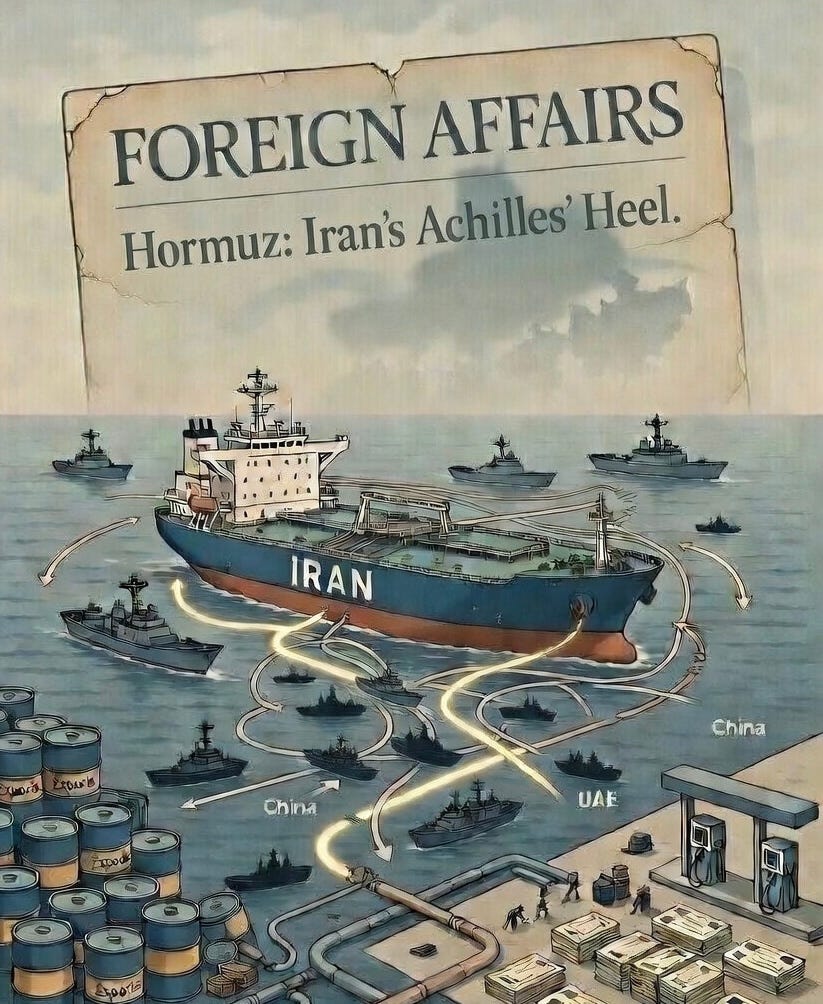
Miad Maleki’s “For Iran, Hormuz Is More a Weakness Than a Weapon” appeared in Foreign Affairs on April 15, the same day the US naval blockade entered its third day. Maleki is a former Associate Director of the Office of Foreign Assets Control at the US Treasury, so he knows how sanctions work from the inside, and several of his technical points on Iran’s sanctions-evasion mechanics deserve to be taken seriously. The conclusion his piece reaches, however, sits in a long tradition of Foundation for Defense of Democracies (FDD) analysis that has consistently predicted Iranian economic collapse under pressure and been consistently wrong.
That track record is not incidental to evaluating this piece – it is directly relevant, because the same structural conditions that undermined the previous predictions are present here: a sanctions-hardened economy that has already restructured around constraint, a regime with demonstrated coercive capacity, and a survive-and-exhaust doctrine that has been refined across four decades of external pressure.
The Playbook
The 2012 sanctions tightening was supposed to break the regime. The 2018–19 maximum pressure campaign – which cut Iranian oil exports from around 2.5 million barrels per day to well under a million – was supposed to make continued resistance economically impossible. Neither produced the predicted result, yet the FDD produced no institutional recalibration. The same analysis reappeared with updated figures.
“The blockade makes continued resistance economically impossible” is that analysis reappearing again.
The FDD was founded with Iran regime change as a central policy objective. Its funding base, board composition, and publication history all reflect a consistent prior: Iran is more vulnerable than mainstream analysts think, pressure works, engagement is naive, and collapse is closer than the consensus believes. That prior has been wrong across three administrations and multiple pressure campaigns. Maleki’s OFAC background gives him genuine expertise on sanctions mechanics, but it does not insulate the piece from that institutional context, and it does not explain why this episode should produce a different result from the structural dynamics that governed the previous ones.
The Valuation Dispute
Maleki argues at length that Iran’s export revenues were largely illusory in practice. Intermediaries and brokers extract commissions at every stage of the sanctions-evasion supply chain, and what profit remains accumulates in yuan-denominated accounts in China. Sanctions prevent Iran from converting or repatriating these funds, and the widely cited $139 million daily revenue figure was a lifting ceiling derived from tanker-loading data rather than confirmed sales or accessible receipts. That is a credible argument, grounded in insider knowledge of how sanctions evasion actually works.
He then calculates that stopping exports will cost Iran $276 million per day and describes the blockade as “much more devastating” than Iran’s own strait closure. The tension here is not a simple logical contradiction – exports can be simultaneously low in net realised value and structurally necessary for the system to function, since even thin-margin flows finance imports indirectly through barter, clearing arrangements, and shadow channels. The real question is which parts of those systems break when flows stop, and at what threshold of disruption. Maleki treats that threshold as given rather than demonstrated, and his devastation figures assume near-total flow disruption – precisely the enforcement standard that the first 48 hours of the blockade calls into question.
How the Iranian Economy Actually Works
The deeper issue is that Maleki’s framework implicitly assumes the textbook export-revenue-to-imports-to-economic-function chain is intact – that disrupting exports severs the economy’s lifeline. Iran has spent a decade deliberately breaking that chain.
The primary purpose of oil export revenue is to pay for imports. Hard currency earned from exports finances the import basket – intermediate goods, capital equipment, pharmaceuticals, grain. The loss of that currency compresses the import basket: fewer goods arrive, shortages follow, and prices rise. The sequence begins with the import constraint, even if it propagates more broadly through domestic pricing and expectations once under way. That sequence is real and genuinely damaging.
But Iran has already been living inside a compressed version of that sequence for years. Sanctions have already restructured the economy around lower import levels. Grey-market channels, barter arrangements, bilateral settlement in non-dollar currencies, and domestic substitution where feasible are not workarounds bolted onto a normal economy – they are the economy. The formal transmission mechanism from export revenue to imports to economic function was already significantly degraded by sanctions, and Iran adapted accordingly. The economy has restructured around constraint, which means additional export pressure is incremental rather than transformational. That is exactly why the blockade’s enforcement threshold matters: significant but partial disruption produces incremental damage, while near-total disruption might trigger the cascade Maleki describes. The evidence so far points toward the former.
A less-adapted economy facing this shock for the first time would face acute crisis. Iran faces a worsening of a chronic condition it has already learned to manage. As argued in Damage, Not Collapse, that distinction is the correct analytical frame – and it is the one Maleki’s piece consistently elides.
What He Gets Right
The fuel deficit point is his strongest and deserves acknowledgment. Iran’s ageing refining infrastructure produces roughly 26 million gallons of gasoline daily against domestic consumption of 30 million – a structural 13% shortfall covered by imports through Hormuz, largely through maritime barter arrangements routed via the UAE. Fuel prices have already surged roughly 40% since the conflict began, ration card limits have been cut, and Iran holds only around 12 days of fuel reserves, well below the IEA’s 90-day standard. That is a real vulnerability, more acute than the oil export pressure alone.
The 13% shortfall is serious but is being managed through rationing – states that run out of fuel panic, while states that ration still retain sufficient control over distribution to sequence the shortage. How long controlled rationing holds under a sustained blockade is genuinely uncertain, however, and it is the variable that most determines whether Maleki’s damage scenario edges toward a collapse scenario. Chabahar on the Gulf of Oman provides partial rerouting capacity, though well below Bandar Imam Khomeini’s throughput, and that margin is crucial for the timeline.
The yuan repatriation mechanics are also important. If Iran’s China earnings are structurally inaccessible, the 150 million barrels of Iranian crude afloat outside the Strait – estimated by Energy Aspects’ Richard Bronze as an offshore buffer extending Iran’s revenue stream – generates deferred paper revenue rather than deployable cash. That weakens the buffer’s practical value, though Iran can still use oil-for-goods arrangements and bilateral settlement mechanisms that bypass dollar clearing.
The Limit of Pain
The deeper problem is what “the population has reached the limit of economic pain it can tolerate” actually means in the Iranian context. Maleki’s collapse scenario is not a simple “protests equal regime change” argument – he combines currency collapse, fuel shortages, and food system stress into a compound pressure scenario. That is a more sophisticated framing than it is sometimes given credit for. The problem is that he overstates how directly compound economic stress translates into regime failure, particularly in a system where the coercive architecture remains intact.
The January protests were suppressed through force at enormous cost to the regime’s legitimacy. That is evidence of a regime with sufficient coercive capacity to survive at enormous moral cost, not one approaching collapse. The rial has fallen from 817,000 per dollar at the start of 2025 to over 1.5 million today, and banks are limiting citizen withdrawals to $18–30 per day. These are serious indicators of acute financial stress. But Iran has operated under acute financial stress since 2012, and the regime’s survival strategy has never depended on the population being comfortable. It has depended on the IRGC remaining loyal and the coercive apparatus remaining intact. Neither of those conditions has changed, and Maleki provides no evidence that either is close to changing. Elite cohesion under sustained material stress is a real and understudied variable in Iranian politics, but it is not the argument Maleki makes.
What the Piece Misses
Maleki does not engage at all with the constraint on the US side. As Energy Aspects’ Bronze concluded in the FT, “the administration is unlikely to be able to afford to wait”. Pressure that the blockading side cannot sustain is not decisive pressure, regardless of how much damage it causes in the interim. Trump is managing $100+ oil against a domestic backdrop already absorbing tariff-driven inflation, equity market volatility, and recession risk – and as argued in Three Withdrawals Running Simultaneously, the Iran shock is landing in a global financial system whose absorption capacity is already being compressed by simultaneous liquidity withdrawals from Japan, the GCC, and China through independent channels that monetary policy cannot fully offset. The IIF has identified a convexity point at which thinning inventory buffers mean the same disruption produces progressively larger price increases — a dynamic that makes prolonged blockade more economically dangerous for Washington than Maleki acknowledges.
Iran’s optimal play remains survive-and-exhaust, as argued in Who Is Actually Winning the Iran Campaign – a doctrine that requires outlasting Washington’s political clock, not matching its firepower.
The Conclusion
Maleki’s piece is more substantive than typical FDD output – the sanctions mechanics are credible, the fuel deficit is real, and the Jask pipeline analysis is well-evidenced. It deserves serious engagement rather than dismissal on institutional grounds alone, which is why this piece addresses it at length.
But “economically impossible” is a strong claim, and strong claims require correspondingly strong evidence, particularly when the institution making the claim has predicted the same outcome under structurally similar conditions before and been wrong each time. The Iranian regime is weaker than it was in 2018, it is more financially stressed, and the coercive cost of internal suppression is rising. Yet it is also true that a regime which suppresses protest waves through force, holds the enrichment capability it regards as its primary deterrent against regime change, and has been running survive-and-exhaust as its strategic doctrine for four decades, is not a regime on the verge of collapse because its oil storage tanks are filling and its fuel reserves cover only twelve days. The verdict holds especially when the blockade enforcing those constraints has not demonstrated the near-total effectiveness that Maleki’s timelines require.
Exports are not irrelevant, particularly for the fuel and grain flows that have the shortest system tolerance. Yet they are less decisive than Maleki’s framework assumes. Because the economy has already restructured around constraint, additional export pressure is incremental rather than transformational, operating on a system that has absorbed the initial adjustment rather than one encountering the constraint for the first time.
That is the damage-not-collapse distinction, and it provides the right analytical frame for evaluating arguments that consistently treat damage as proof of imminent collapse.