
The Strategic Victory Condition
But we’ve seen this before… many times now

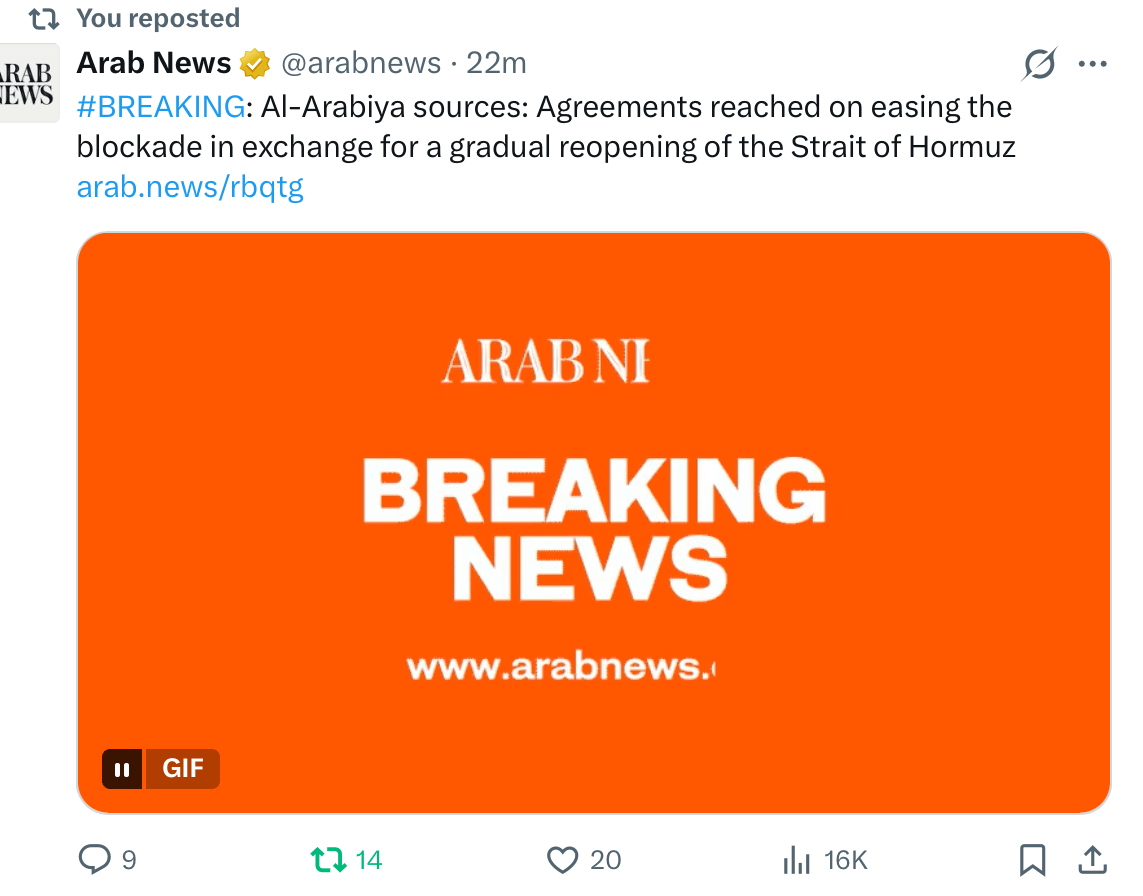
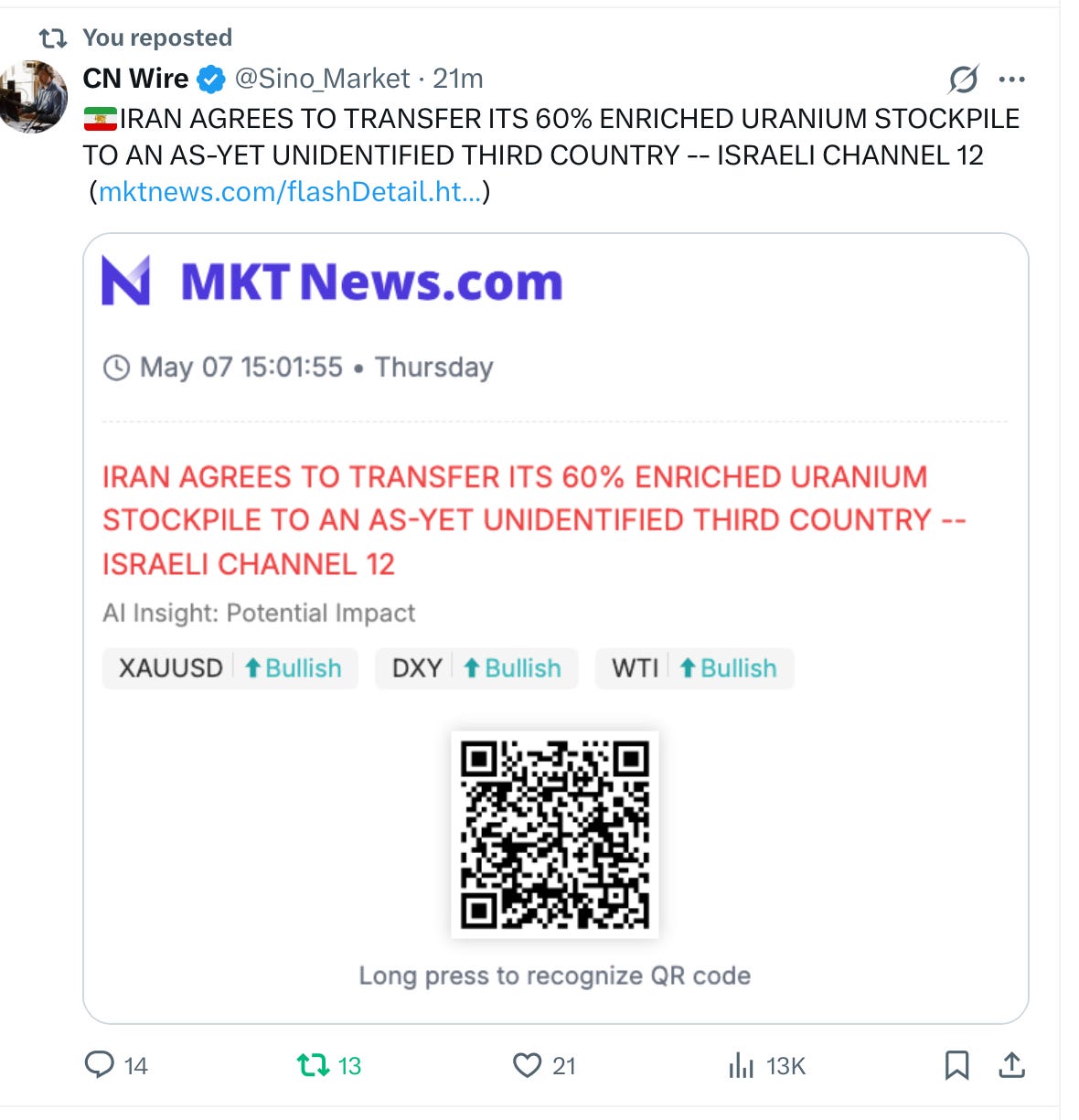
Two headlines landed within minutes of each other this evening. Al-Arabiya reporting agreements reached on easing the blockade in exchange for gradual Hormuz reopening. Israeli Channel 12 reporting Iran has agreed to transfer its 60% enriched uranium stockpile to a third country. Both unverified. Both consistent with a framework that, if real, changes the picture significantly. Here’s why Iran might actually accept it this time.
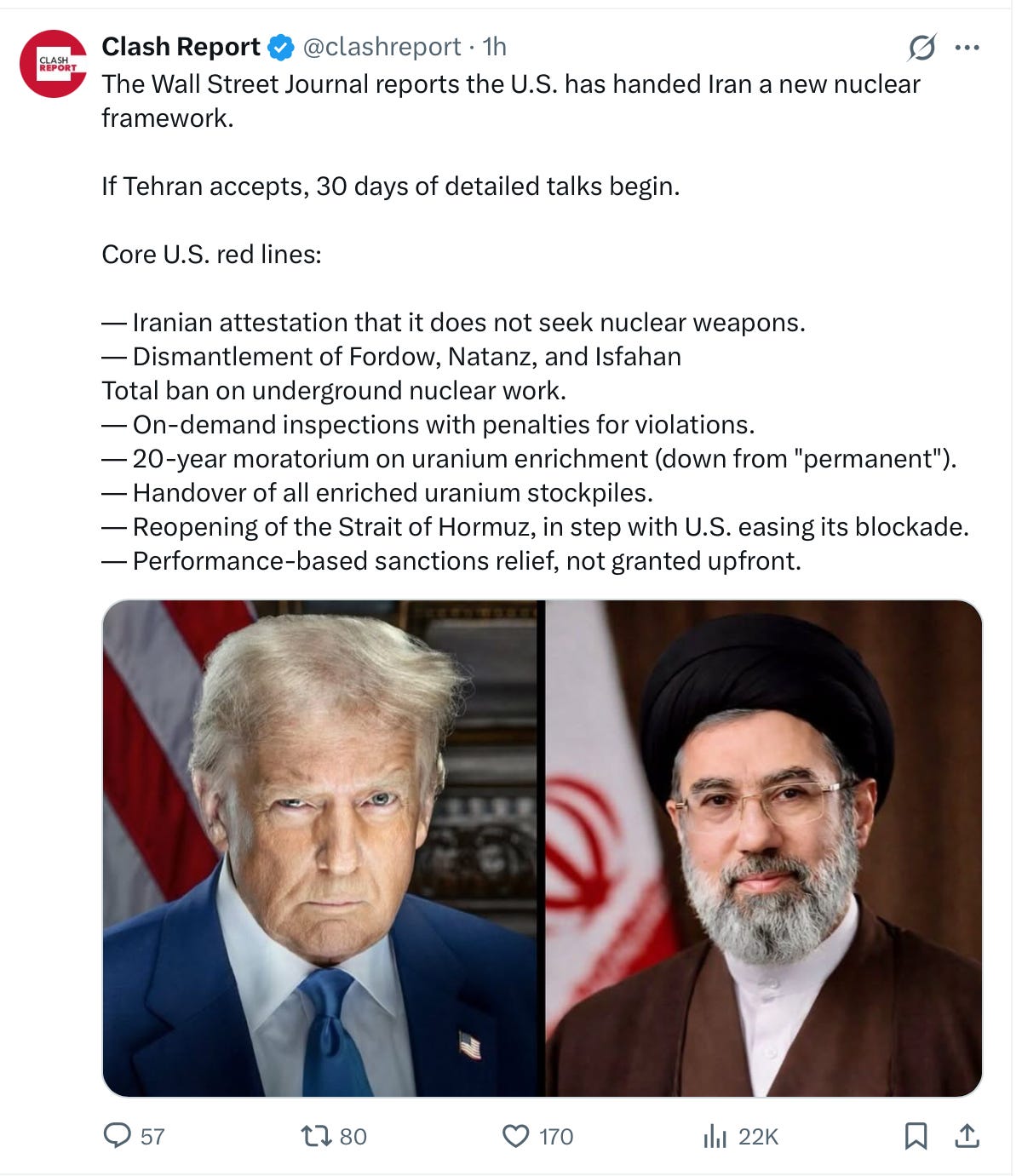
The WSJ is reporting the US has handed Iran a new nuclear framework. The core terms look maximalist on paper – dismantlement of Fordow, Natanz, and Isfahan, a 20-year enrichment moratorium, full stockpile handover – and the conventional view is that Iran will never accept the enrichment terms.
But there might be a new twist.
Iran’s willingness to make nuclear concessions has never been purely about the nuclear terms. It has always been about what the regime can claim as the political outcome of the confrontation. And the political outcome of this war, from Tehran’s perspective, is one of the strongest negotiating positions Iran has occupied in decades.
Consider what Iran can now claim. It absorbed six weeks of the most intensive US-Israeli air campaign the region has seen, kept the Strait of Hormuz closed long enough to spike Brent above $125, and negotiated the April ceasefire on the basis of its own 10-point framework.
Since then:
Project Freedom, the US operation to reopen the Strait, was shut down within 36 hours by Saudi Arabia withdrawing access to Prince Sultan Air Base after Trump announced it on social media without coordinating with Gulf allies.
The UAE exited OPEC mid-conflict.
The IEA described the disruption as the largest in the history of the global oil market.
The US has now moved from demanding a permanent ban on enrichment to accepting a 20-year moratorium.
That is an extraordinary set of outcomes for a country that was absorbing strikes on its military and nuclear infrastructure six weeks ago.
The regime does not need to describe the nuclear terms as a victory because it can describe the war itself as the victory, and thus frame the settlement as collecting the economic dividend of a strategic success.
Khamenei’s death removes the symbolic obstacle that would have made any nuclear concession politically toxic under the prior leadership. A new leadership structure has more room to frame a settlement as a fresh chapter rather than a capitulation. The 20-year moratorium is also domestically defensible in a way the permanent ban never was – enrichment is preserved in principle, the suspension is time-limited, and Iran trades a capability it cannot fully use right now for sanctions relief and Hormuz reopening with immediate economic value.
The harder sell is Fordow and Natanz dismantlement. The IRGC has an institutional interest in preserving that infrastructure, but if the regime frames it as trading damaged facilities for economic recovery and recognition of Iran’s regional standing, it has a workable narrative for the domestic audience.
None of this makes acceptance certain. The verification architecture and the sequencing of sanctions relief versus Hormuz reopening are the most likely sticking points in any 30-day negotiation.
Yet the strategic victory condition – the political context under which a nuclear concession becomes survivable domestically – is as close to being met as it has been at any point since the JCPOA collapsed.
Trump seeing Xi next week adds a further boost. Trump wants this war finished – he has postponed his visit to China once already. This week China’s Ministry of Commerce directed all Chinese entities not to recognise, enforce, or comply with US secondary sanctions on Iran, a direct counter to the US Treasury sanctioning of Chinese refiners for buying Iranian crude. Xi is arriving at the summit having just fired that shot. Trump needs the meeting to go well and Xi knows it.
This is clearly a strategic loss for the US and will result in an agreement that is functionally little different to the JCPOA – “the worst deal in history” – that Trump walked away from in his first term. Yet, he is a master at spinning fantasy into apparent reality that his base eagerly swallows, so he will be expecting to do that again.
While the 20-year moratorium demand might seem like an important step-down (compared to previous demand of permanent ban) from a US perspective, however IMO the Iranian government would still probably see this as an unpalatable concession to make.
This is because, a 20-year pause would likely lead to genuine and debilitating institutional loss of knowledge, expertise and experience that its vast team of nuclear scientists have accumulated over the years. This is probably the American motivation also in proposing a 20-years break.
Further, it would also lead Iran to be dependent on external support for its nuclear civilian program as well (which is a matter of great national pride for the Iranians), which technically can be weaponized as a leverage against it by the LEU supplier at some point in the future.
Further, this war as well as other contemporary conflicts have demonstrated that the only truly resilient energy generation option that remains off the table for an adversary's strikes in a conflict are the nuclear power plants (although they are also increasingly being targetted to some extent in recent years - ZNPP in Ukraine, Kursk NPP in Russia and Bushehr NPP in Iran). This serves as an incentive for Iran to expand its civilian nuclear program and have domestic enrichment capabilities.
Regarding the transfer of HEU stockpiles, I am hypothesizing that the unnamed third country which may take possession by mutual consent of all parties involved is Russia, because that has been the only country on record that has consistently offered to do so. Iran also probably wants to ensure that even if it decides to relinquish control, its HEU stockpile is not transferred to US or US allied control because in theory this very HEU can be used in US nuclear bombs which can be threatened to be used (or even used) against it in a future crisis (US has always reserved for itself the right for first use). This only leaves Russia and China as its options (North Korea would never be acceptable to US).
Also, the deal is notably ambiguous on the terms of re-opening the Strait of Hormuz. Formalizing its control of the Strait in an internationally recognized institutional and legal framework has emerged as the key element of the Iranian strategic policy now, since the war has reinforced the perception that the only true deterrent for American military force and existential attacks against it, is the closure of the Strait.
Further, Israeli buy-in is not guaranteed at all, because Israelis have become increasingly paranoid over the highly advanced Iranian missile program which performed quite well against their sophisticated AD. They also would not be happy about the fact that the deal stipulates no cessation of support to Iranian proxies in the region, considering that the Hezbollah is increasingly becoming a problem that IDF is struggling against on the ground. US government therefore would have to convince the Israelis first to not sabotage any deal and fall in line with US national interests, and that is by no means a given, considering how that has been the biggest challenge in the Middle East policies of all US administrations.
All this leads me to believe that although there has been some moderation in positions, there still remains substantial ground to bridge between the parties involved.