
Pausing, Not Ending
Hormuz is at 8% of pre-war flow, Iran has rejected a compromise, and the market keeps reversing the old adage, buy the rumour and sell the fact


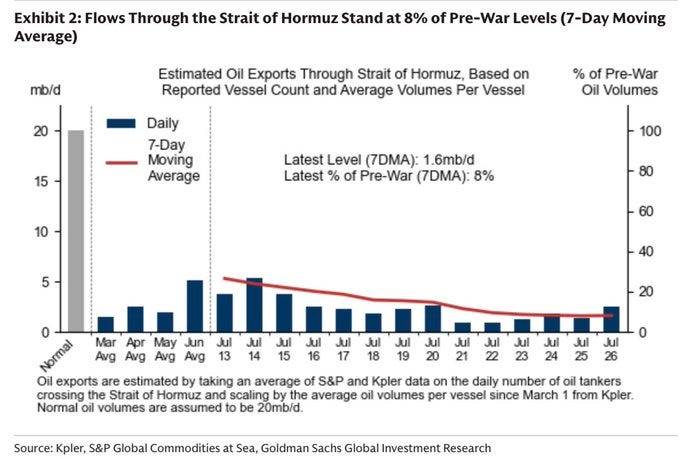
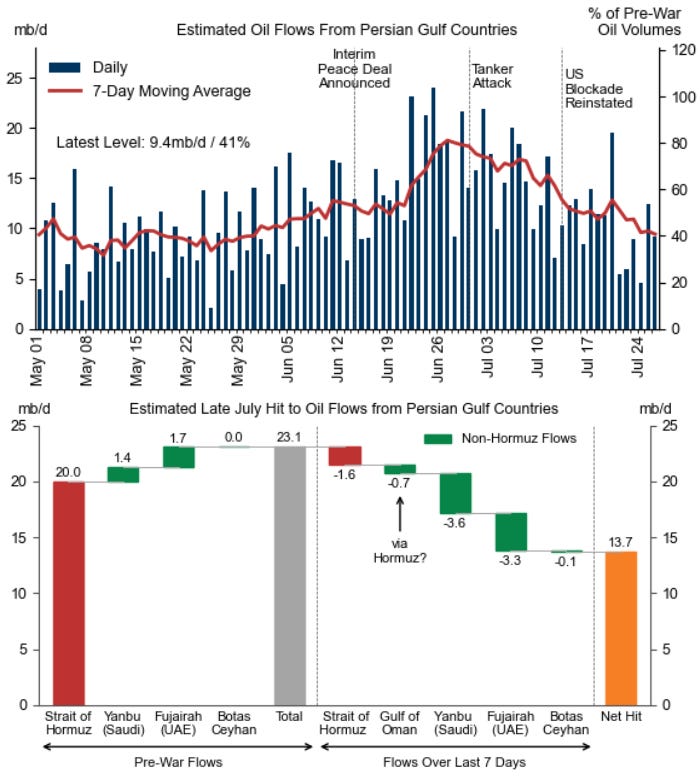
The war has paused rather than resolved, yet again, and the difference is starkly illustrated by the flow data. Goldman Sachs estimates reported oil exports through Hormuz at just 1.6 mb/d (million barrels a day), 8% of the pre-war 20 mb/d.
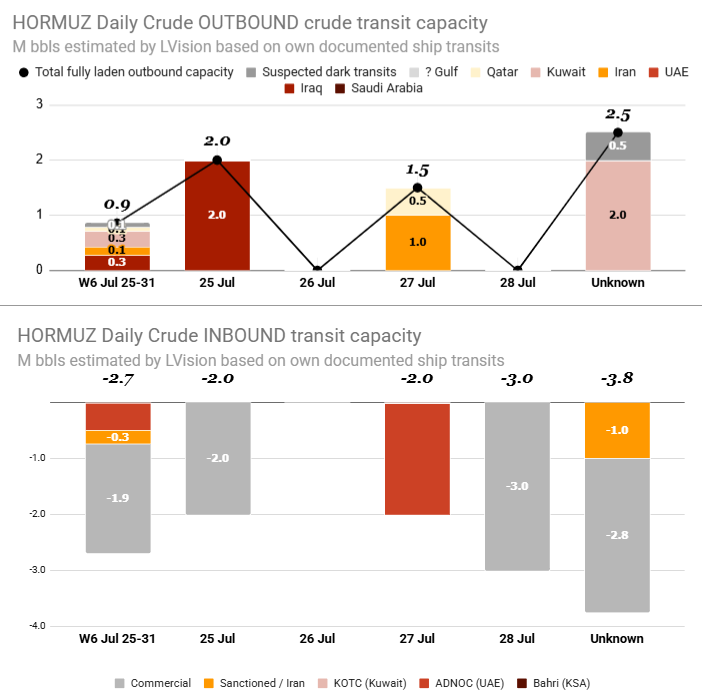
Vessel tracking has recorded no documented outbound crude capacity through the strait on either 26 or 28 July. Yet, as has been the way of this event, oil has swung with the diplomacy rather than the physical picture. Brent fell from last Thursday’s intraday high above $100 to around $84 by Monday morning. It edged up to roughly $84.50 Monday evening after Iran’s missile attack on US forces, while WTI moved more, from below $78 to about $83.
As with previous pauses, this one has not seen a clean respite in strikes. Iran launched ballistic missiles at American forces in Jordan on 28 July, all intercepted according to CENTCOM. The launch came hours after Trump met Israeli Prime Minister Netanyahu at the White House, and after Trump had told Axios he was “considering a massive attack, bigger than ever before… we are all set for it”, while separately repeating the bridges threat – “I could take out most bridges in less than an hour”. CENTCOM also disclosed that Iran-aligned militias have attempted more than 600 attacks on US citizens and facilities in Iraq between February and April alone, so this Jordan strike is one incident in a much larger campaign, rather than an isolated one. The US hadn’t resumed its bombing campaign as this was being written, making this an armed pause rather than a second ceasefire. Trump says talks are under way, but Iran says they aren’t. Messages are moving through Oman, but the underlying dispute has changed from whether Hormuz reopens to who controls it once it does.
The news that is circulating regarding diplomacy overstates what is actually confirmed. Reuters and Al Jazeera both report, citing Iran’s deputy foreign minister Kazem Gharibabadi, that Oman proposed a Malacca-style arrangement – equal transit lanes, voluntary rather than compulsory fees – and that Iran rejected it, on the stated grounds that equal division “doesn’t address Iran’s security concerns”. Iran’s counter-proposal was one shipping lane entirely within Iranian territorial waters, part of the other lane also under Iranian control, and no third country permitted to conduct mine clearance even at Oman’s invitation. This rejection is direct from Gharibabadi himself rather than from anonymous officials, but some reporting has gone further, describing unnamed mediators as “incensed” and casting Iran’s counter-proposal as grabbing “the lion’s share” of the strait. Neither Reuters nor Al Jazeera use language anywhere near that strong, thus it reads more like editorial colour from a source with an interest in making Iran look like the unreasonable party. It is also useful to note that the current round of Iranian attacks traces back to Oman, which had set up a US-backed shipping corridor along its own coastline without Iranian approval, prompting Tehran to resume strikes on shipping and the US to respond in kind. Gharibabadi also directly contradicted Trump’s public account of where things stand – Iran has not submitted a single request to negotiate with Washington in the past fifteen days, despite Trump repeatedly telling reporters that Iran wants to talk.
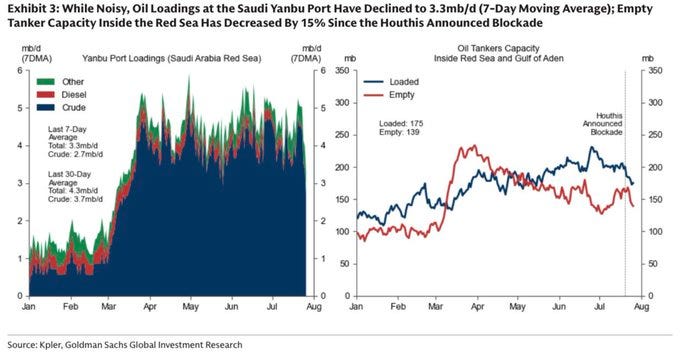
The Red Sea vulnerability flagged previously is now apparent in the data. Yanbu port loadings have fallen to 3.3 mb/d on a seven-day average, down from 4.3 mb/d over the trailing month, and empty tanker capacity inside the Red Sea and Gulf of Aden has dropped 15% since the Houthis announced their blockade. The bypass that had been absorbing a large share of the Hormuz shortfall is thus tightening under the weight of the second front.
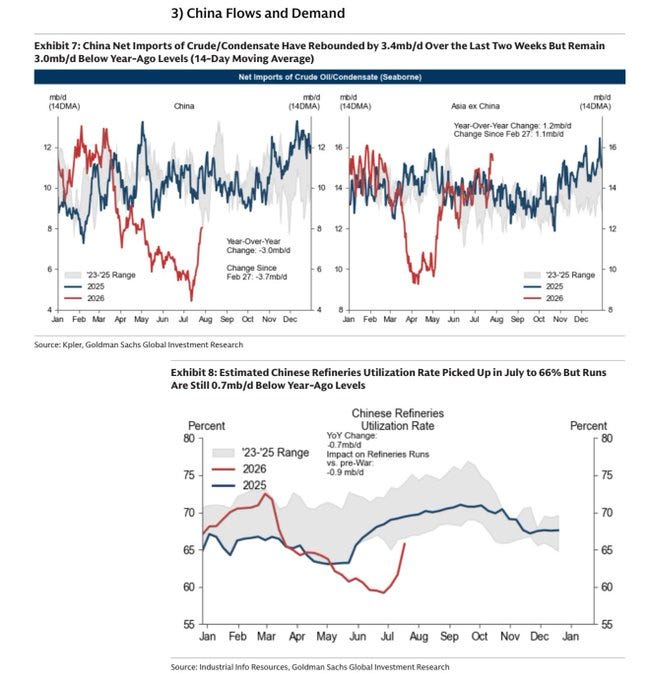
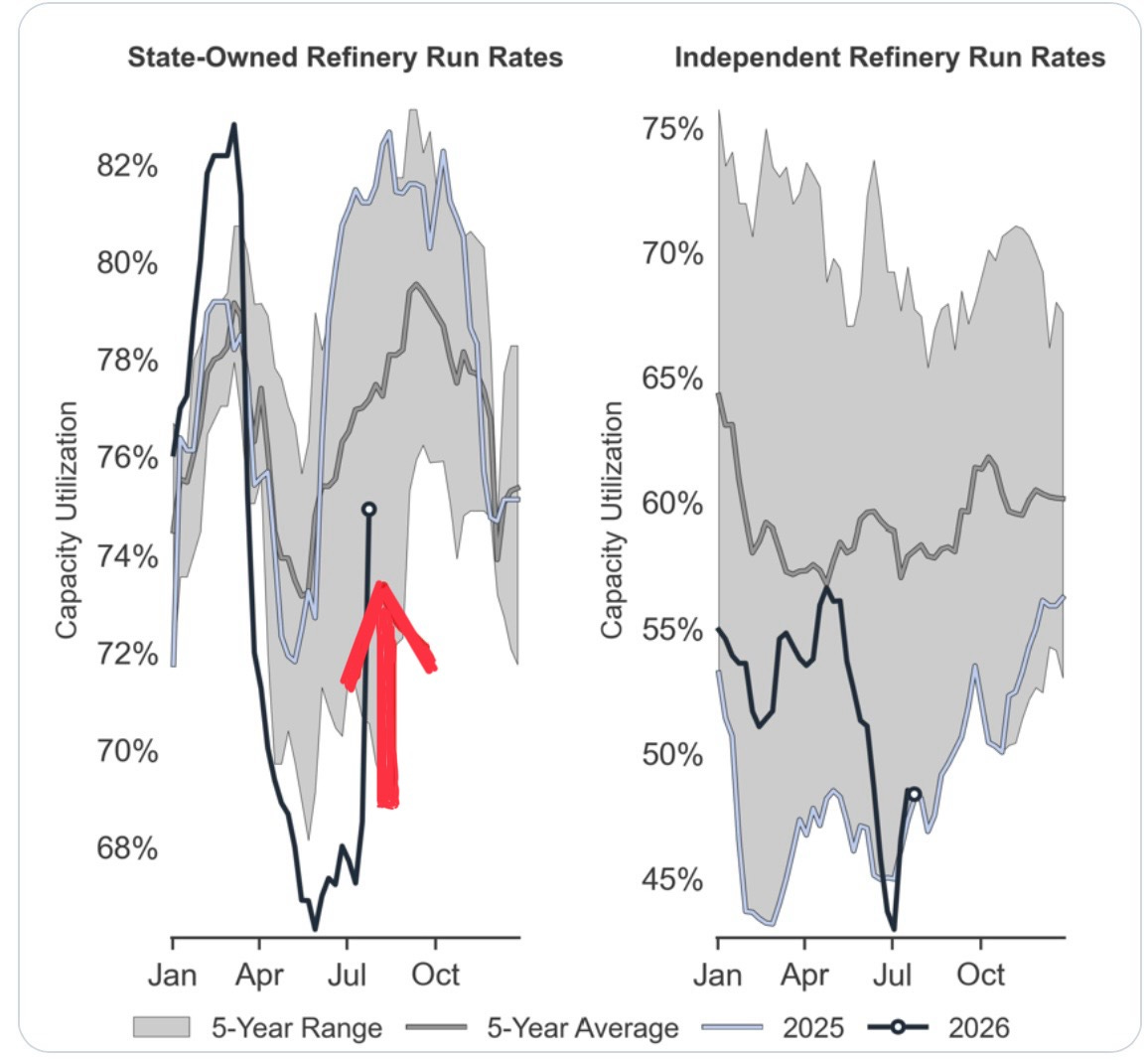
China’s position has been highlighted several times previously as the major swing factor, and there are early signs it is adjusting its stance. Net crude imports are up 3.4 mb/d over the past fortnight, though still 3 mb/d below levels a year ago, and refinery utilisation climbed to 66% in July. That is a partial rebound, but the barrels recorded as arriving now were probably bought weeks earlier, when prices were lower.
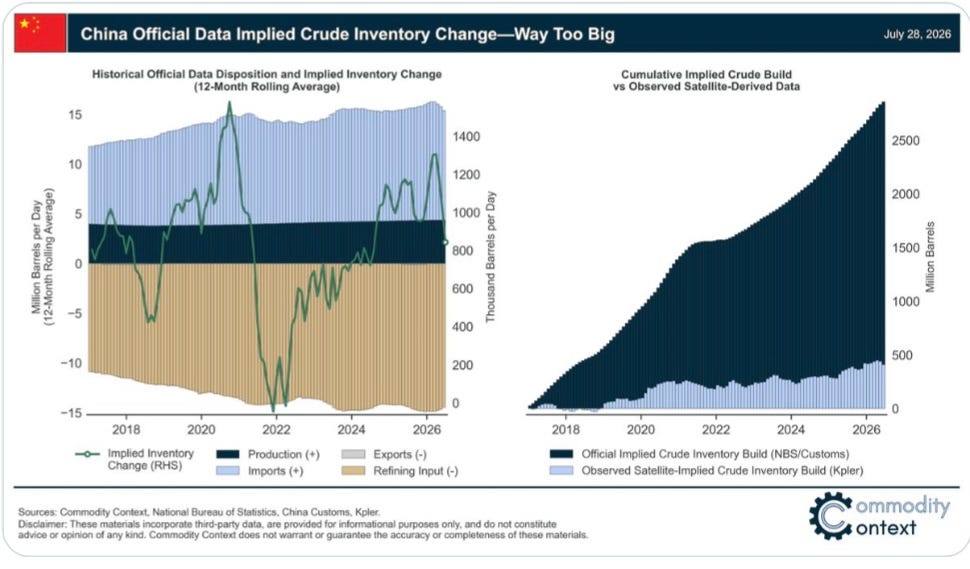
Uncertainty remains, nonetheless, over two related variables: whether China keeps buying at current prices and how large China’s pre-war cushion actually was in the first place. Official Chinese data implied a stockbuild near 1.4 mb/d in the year before the war, with a cumulative build since 2017 approaching 3 billion barrels. Satellite-tracked estimates, however, put the cumulative observed increase since 2017 far lower – closer to 450 mb at its peak, roughly one-sixth of the build implied by official data. In the year immediately before the war, those observed stocks rose by around 0.375 mb/d, just over a quarter of the official implied rate of 1.4 mb/d. That suggests the additional pre-war cushion was substantially smaller than the official flow data implies.
The SPR (US Strategic Petroleum Reserve) debate is complex, needing a more considered view than “Washington is bluffing”, and so a full treatment will be considered in a separate piece. Two things are worth raising now, however.
First, DOE (US Department of Energy) has already signed contracts reducing the reserve to roughly 282 mb once current deliveries finish. This is below the 300 mb some analysts treat as a hard floor. If that was the real floor, committing to deliveries past it could expose DOE to legal risk, so the contracts themselves are evidence that it is not the floor.
Second, DOE’s claim that the real floor is only 70 mb also has more behind it than a talking point invented for this crisis. I was sceptical of DOE’s 70 mb figure last week, mostly on incentives – no government understates its reserves without a reason. Although the new evidence doesn’t fully settle that either way, it does complicate it. A 2016 DOE report said each site must be able to draw down until 90% of its inventory is depleted and the same standard was repeated in DOE’s most recent report this year. It works out that 10% of the SPR’s 714 mb capacity is almost exactly 70 mb. That’s a decade-old paper trail, not a recent invention. Whether 70 mb is the real floor, or whether it is higher, depends on unknown technical factors, such as how much oil the Gulf Coast pipelines can actually carry rather than how much is in the caverns. For now, the observation I made last week looks weaker than it did then, although the reasoning behind it still holds until demonstrated otherwise. Still, the more interesting and crucial constraint may not be how much oil is left underground at all.
Positioning data in the futures market backs up the buy-the-rumour-sell-the-fact reversal already made above. In early July traders were holding near their lowest net long position on Brent and WTI combined in years – these were bets for a calm market, not an escalating one. This setup means that if Chinese buying picks up or the coordinated SPR releases slow, all those traders would have to buy back their positions at once – which is exactly how a short squeeze starts.
Not everyone reads Trump’s decision to hold off on renewed strikes as good news, either. One argument is that Iran is negotiating from a position of confidence, not weakness, and has little reason to make the concessions that a complete resolution needs. If that is right, the market has rushed to price in peace at least three times already this year, wrongly each time. This may be yet another.
The two-spikes thesis remains live. Hormuz’s reported oil-export flow is running at roughly one-twelfth of its pre-war level, the Red Sea bypass is now tightening rather than absorbing the shortfall cleanly, China’s suppressed imports may be returning, and the reserve debate continues to be uncertain yet more nuanced than headline numbers suggest. The thesis does not require strikes to resume; rather, it just needs the situation to remain unresolved since those conditions together still point toward a crude supply shock.
The oil shortage may turn out to be like bankruptcy, first slowly then all at once. What’s interesting to me is our worldwide collective level of denial. You’d think that serious planning would be ongoing regarding how countries, communities and businesses can adapt and create new systems which thrive on 15 to 20 % less
oil. But nooooo. We want what we want which is what we had.